 Back
Equations and Applications: Rational, Radical, and Quadratic Forms
Study Guide - Smart Notes
 Tailored notes based on your materials, expanded with key definitions, examples, and context.
Equations & Inequalities
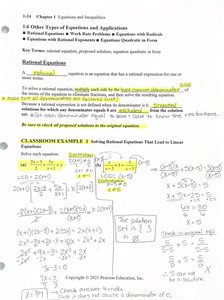
Rational Equations
Rational equations are equations that contain rational expressions, which are fractions with polynomials in the numerator and denominator. Solving rational equations often involves finding a common denominator and checking for extraneous solutions.
Definition: A rational equation is an equation that has a rational expression for one or more terms.
Key Steps:
Identify the least common denominator (LCD) of all rational expressions.
Multiply each term by the LCD to clear denominators.
Solve the resulting equation.
Check all proposed solutions in the original equation to avoid extraneous solutions.
Extraneous Solutions: Solutions that do not satisfy the original equation, often caused by multiplying both sides by an expression containing a variable.
Example: Solve \( \frac{2}{x} + \frac{3}{x+1} = 1 \)
Find LCD: \( x(x+1) \)
Multiply both sides by LCD, solve for x, and check solutions.
Equations with Radicals
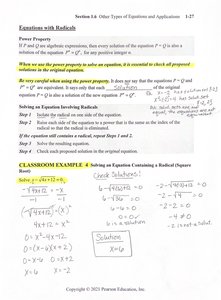
Equations with radicals involve terms containing square roots or other roots. Solving these equations requires isolating the radical and then raising both sides to the appropriate power to eliminate the radical.
Power Property: If \( P = Q \), then every solution of \( P = Q \) is a solution of \( P^n = Q^n \) for any positive integer n.
Key Steps:
Isolate the radical expression.
Raise both sides to the power that eliminates the radical.
Solve the resulting equation.
Check all proposed solutions in the original equation to avoid extraneous solutions.
Example: Solve \( \sqrt{4x+12} = x \)
Square both sides: \( 4x+12 = x^2 \)
Rearrange and solve: \( x^2 - 4x - 12 = 0 \)
Check solutions in the original equation.
Equations with Two Radicals
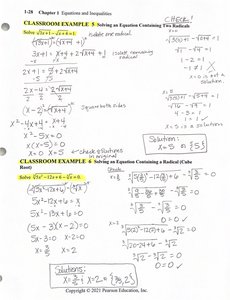
Some equations contain two radical expressions. The process involves isolating one radical, squaring both sides, and then repeating the process for the second radical.
Key Steps:
Isolate one radical.
Square both sides to eliminate the first radical.
Isolate the remaining radical and repeat.
Solve and check all solutions.
Example: Solve \( \sqrt{x+1} + \sqrt{x-1} = 4 \)
Isolate one radical, square both sides, and solve.
Check solutions for extraneous roots.
Equations with Rational Exponents
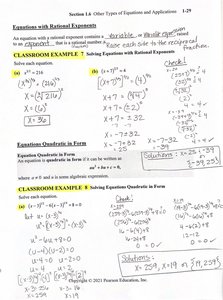
Equations with rational exponents involve variables raised to fractional powers. These can often be solved by raising both sides to the reciprocal of the exponent.
Definition: A rational exponent is an exponent that is a fraction.
Key Steps:
Isolate the term with the rational exponent.
Raise both sides to the reciprocal of the exponent.
Solve and check solutions.
Example: Solve \( x^{2/3} = 4 \)
Raise both sides to the \( \frac{3}{2} \) power: \( x = 8 \)
Check solution in the original equation.
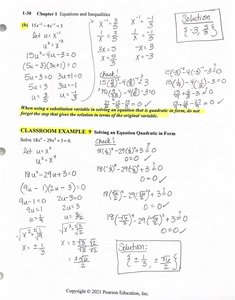
Equations Quadratic in Form
Some equations are not quadratic but can be rewritten in quadratic form by substituting a variable for a power of x. This allows the use of quadratic solution methods.
Definition: An equation is quadratic in form if it can be written as \( au^2 + bu + c = 0 \) where \( u \) is a function of x.
Key Steps:
Substitute \( u = x^n \) or another appropriate expression.
Solve the resulting quadratic equation for \( u \).
Back-substitute and solve for x.
Check all solutions in the original equation.
Example: Solve \( x^4 - 5x^2 + 6 = 0 \)
Let \( u = x^2 \), so equation becomes \( u^2 - 5u + 6 = 0 \)
Solve for \( u \), then for \( x \).
Check solutions in the original equation.
Additional info: These notes cover advanced equation-solving techniques relevant to College Algebra, including rational equations, radical equations, equations with rational exponents, and equations quadratic in form. Each example emphasizes the importance of checking for extraneous solutions, a critical step in algebraic problem-solving.
