 Back
BackExam 3 Review: Polynomial and Rational Functions (College Algebra)
Study Guide - Smart Notes
 Tailored notes based on your materials, expanded with key definitions, examples, and context.
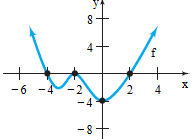
Q1. Find a polynomial function f(x) of least possible degree having the graph shown.
Background
Topic: Polynomial Functions and Graphs
This question tests your ability to interpret a graph and construct a polynomial function based on its zeros, their multiplicities, and the end behavior.
Key Terms and Formulas:
Zero (Root): A value of x where f(x) = 0.
Multiplicity: The number of times a zero is repeated. If the graph touches the x-axis and turns, the zero has even multiplicity; if it crosses, the multiplicity is odd.
End Behavior: Determined by the leading coefficient and degree of the polynomial.
General Form:
Step-by-Step Guidance
Identify the x-intercepts (zeros) from the graph. Look for points where the graph crosses or touches the x-axis.
Determine the multiplicity of each zero by observing the graph's behavior at each intercept. If the graph touches and turns, it's even; if it crosses, it's odd.
Write the polynomial in factored form using the zeros and their multiplicities. For example, if the zero at has multiplicity 2, include .
Consider the leading coefficient. Use the end behavior (does the graph rise or fall as ?) to determine if the coefficient is positive or negative.
Try solving on your own before revealing the answer!
Final Answer:
The zeros are at (multiplicity 2), (multiplicity 1), and (multiplicity 2). The negative leading coefficient matches the end behavior shown in the graph.
Q2. Determine the real zeros of the polynomial and their multiplicities. Then decide whether the graph touches or crosses the x axis at each zero.
Background
Topic: Zeros and Multiplicities of Polynomials
This question tests your understanding of how the factors of a polynomial relate to its zeros and the behavior of the graph at those zeros.
Key Terms and Formulas:
Zero: Value of x where .
Multiplicity: The exponent of the factor corresponding to the zero.
Touch/Cross: Even multiplicity means the graph touches and turns; odd multiplicity means it crosses.
Step-by-Step Guidance
Set each factor in equal to zero to find the zeros.
For each zero, note the exponent to determine multiplicity.
For each zero, decide if the graph touches (even multiplicity) or crosses (odd multiplicity) the x-axis.
Summarize the zeros, their multiplicities, and the graph behavior at each.
Try solving on your own before revealing the answer!
Final Answer:
The zeros are (multiplicity 2, touches), (multiplicity 3, crosses and flattens out).
Multiplicity determines whether the graph touches or crosses the x-axis at each zero.
Q3. Use the graph to determine the domain and range of the function.
Background
Topic: Domain and Range of Functions
This question tests your ability to read a graph and identify the set of possible input (domain) and output (range) values.
Key Terms:
Domain: All possible x-values for which the function is defined.
Range: All possible y-values the function can take.
Step-by-Step Guidance
Examine the graph to see if there are any breaks, holes, or restrictions on x-values.
For polynomials, the domain is typically all real numbers ().
Look at the lowest and highest points on the graph to estimate the range.
Describe the range based on the y-values the graph attains as x increases or decreases.
Try solving on your own before revealing the answer!
Final Answer:
Domain: Range: $(-\infty, \infty)$
Polynomials are defined for all real x, and the graph extends infinitely in both directions.
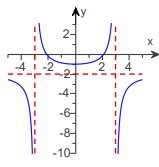
Q4. Find the vertical asymptotes of the rational function
Background
Topic: Rational Functions and Asymptotes
This question tests your ability to find vertical asymptotes by setting the denominator equal to zero and solving for x.
Key Terms and Formulas:
Vertical Asymptote: A line where the function approaches infinity as x approaches a.
Find vertical asymptotes: Set denominator equal to zero:
Step-by-Step Guidance
Set the denominator equal to zero.
Solve the quadratic equation for x to find the values where the function is undefined.
Each solution corresponds to a vertical asymptote.
Write the equations for the vertical asymptotes.
Try solving on your own before revealing the answer!
Final Answer:
Vertical asymptotes at and .
These are the values where the denominator is zero and the function is undefined.
Q5. Find the horizontal asymptote, if any, of the function
Background
Topic: Horizontal Asymptotes of Rational Functions
This question tests your understanding of how the degrees of the numerator and denominator affect the existence and location of horizontal asymptotes.
Key Terms and Formulas:
Horizontal Asymptote: A line that the function approaches as .
Degree comparison: If degree numerator > degree denominator, no horizontal asymptote.
General rule: If degrees are equal, asymptote at .
Step-by-Step Guidance
Identify the degree of the numerator () and denominator ().
Compare the degrees to determine if a horizontal asymptote exists.
If the numerator's degree is greater, there is no horizontal asymptote.
If the degrees are equal, use the leading coefficients to find the asymptote.
Try solving on your own before revealing the answer!
Final Answer:
No horizontal asymptote.
The degree of the numerator (3) is greater than the degree of the denominator (2), so the function does not have a horizontal asymptote.
