Back
BackExponential and Logarithmic Functions: Graphs and Properties
Study Guide - Smart Notes
 Tailored notes based on your materials, expanded with key definitions, examples, and context.
Exponential and Logarithmic Functions
Exponential Functions: Definition and Properties
Exponential functions are mathematical models where the rate of change is proportional to the current value, leading to rapid growth or decay. The general form is:
Standard form:
Continuous growth form:
Where:
a is the initial value (vertical intercept)
b is the growth factor ( for percent growth rate )
r is the continuous growth rate (as a decimal)
Key Properties:
The domain is all real numbers:
The range is for
There is a horizontal asymptote at (unless vertically shifted)
If , the function shows exponential growth; if , it shows exponential decay
Graphs of Exponential Functions
The graph of an exponential function depends on the values of and :
Vertical intercept:
Point:
Long run behavior:
If , as , ; as ,
If , as , ; as ,
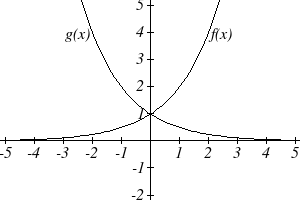
Example: (growth), (decay). Notice is a horizontal reflection of .
Effect of Parameters on the Graph
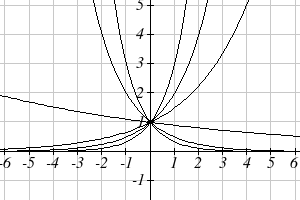
Changing (with fixed) alters the steepness of the graph. The closer is to 1, the less steep the graph.
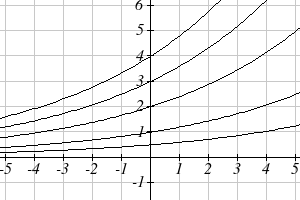
Changing (with fixed) changes the vertical intercept and acts as a vertical stretch/compression.
Transformations of Exponential Functions
Exponential functions can be transformed similarly to other functions:
Vertical stretch/compression:
Horizontal shift:
Vertical shift: (shifts the horizontal asymptote to )
Reflection: Negative reflects across the x-axis; negative exponent reflects across the y-axis
General transformed form:
The horizontal asymptote is .
Exponential Growth and Decay in Applications
Exponential growth: Population, compound interest, etc.
Exponential decay: Radioactive decay, depreciation, etc.
Example: If a population grows by 3% per year, .
Logarithmic Functions: Definition and Properties
The logarithm is the inverse of the exponential function. For , :
if and only if
Common log: , written as
Natural log: , written as
Properties of Logarithms
Inverse properties:
Product property:
Quotient property:
Power property:
Change of base:
Solving Exponential and Logarithmic Equations
To solve , take the logarithm of both sides and use properties to solve for .
To solve , rewrite as .
Example: Solve :
Take of both sides:
Graphical Features of Exponential and Logarithmic Functions
Exponential growth curves rise rapidly for and approach zero for .
Exponential decay curves fall rapidly for and approach zero for large .
Logarithmic functions increase slowly for large and are undefined for .
Summary Table: Exponential Function Features
Parameter | Effect |
|---|---|
Vertical intercept, vertical stretch/compression | |
Growth/decay rate, steepness | |
Vertical shift, moves horizontal asymptote |
Visual Examples