 Back
BackExponential and Logarithmic Functions: Solving Equations and Graphs
Study Guide - Smart Notes
 Tailored notes based on your materials, expanded with key definitions, examples, and context.
Exponential Functions and Equations
Solving Exponential Equations
Exponential equations are equations in which variables appear as exponents. Solving these equations often involves expressing both sides with the same base and then equating the exponents.
Key Point 1: If possible, rewrite both sides of the equation with the same base.
Key Point 2: Once the bases are the same, set the exponents equal to each other and solve for the variable.
Key Point 3: If the equation cannot be rewritten with the same base, logarithms may be used to solve for the variable.
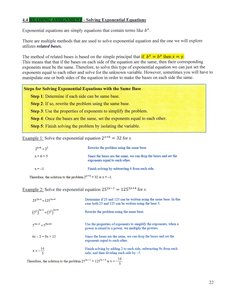
Steps for Solving Exponential Equations with the Same Base:
Express if each side can use the same base.
Rewrite each side as a power with the same base.
Set the exponents equal to each other.
Solve the resulting equation for the variable.
Check your solution in the original equation.
Example: Solve the equation .
Rewrite $32, so . Therefore, and .
Solving Exponential Equations Graphically
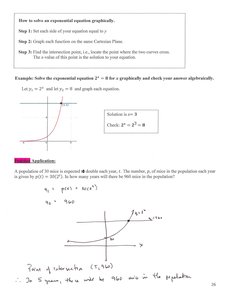
Exponential equations can also be solved graphically by plotting both sides as separate functions and finding their intersection point.
Step 1: Set each side of the equation equal to .
Step 2: Graph both equations on the same axes.
Step 3: The -coordinate of the intersection point is the solution.
Example: Solve graphically. Graph and ; the intersection occurs at .
Logarithmic Functions
Definition and Properties
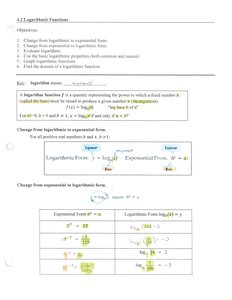
A logarithmic function is the inverse of an exponential function. The logarithm base of a number is the exponent to which $b$ must be raised to produce $x$.
Logarithmic Form: means
Exponential Form: means
Example: because .
Natural Logarithms
Natural logarithms are logarithms with base (Euler's number, approximately 2.718). They are written as .
Key Point:
Calculator Note: Use the button for natural logarithms.
Example: because .
Characteristics of Logarithmic Functions
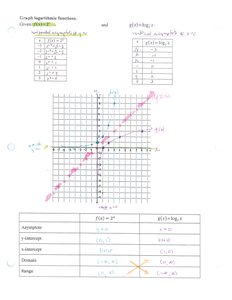
Logarithmic functions have unique graphs and properties:
The domain is (logarithms are only defined for positive real numbers).
The range is .
The -axis () is a vertical asymptote.
Logarithmic functions are the inverse of exponential functions.

Transformations of Logarithmic Functions
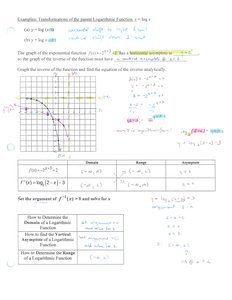
Logarithmic functions can be shifted, stretched, or reflected. The general form is .
Horizontal shift: units right if , left if .
Vertical shift: units up if , down if .
Reflection: Over the -axis if .
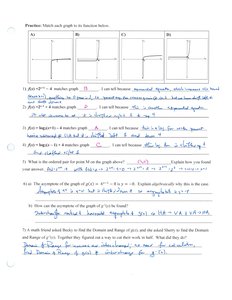
Matching Graphs to Logarithmic Functions
Understanding the effect of transformations helps in matching equations to their graphs. Practice involves identifying shifts, stretches, and reflections from the equation and matching them to the correct graph.
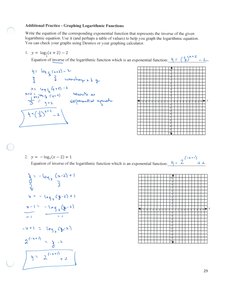
Graphing Logarithmic Functions
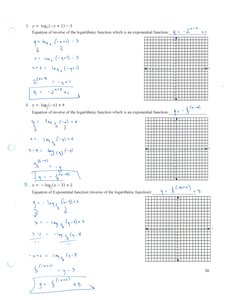
To graph a logarithmic function, plot key points and use the properties of logarithms and their inverses. The inverse of is .
Plot points by evaluating the function at several -values.
Draw the vertical asymptote at .
Sketch the curve, noting the domain and range.
Change of Base Formula
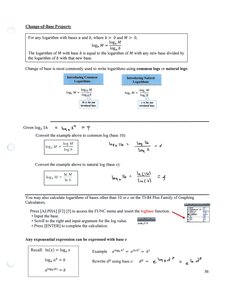
The change of base formula allows you to evaluate logarithms with any base using common or natural logarithms:
, where is any positive value (commonly 10 or ).
Common logarithm: (written as )
Natural logarithm: (written as )
Example:
Solving Logarithmic Equations
Solving by Rewriting in Exponential Form
To solve logarithmic equations, rewrite the equation in exponential form and solve for the variable. Always check that your solution is in the domain of the original logarithmic function (i.e., the argument must be positive).
Step 1: Isolate the logarithm if necessary.
Step 2: Rewrite the equation in exponential form.
Step 3: Solve for the variable.
Step 4: Check for extraneous solutions (the argument of the log must be positive).
Example: Solve . Rewrite as , so .
Summary Table: Exponential and Logarithmic Equations
Equation Type | Method | Example |
|---|---|---|
Exponential | Rewrite with same base, set exponents equal | |
Exponential (different bases) | Take logarithms of both sides | |
Logarithmic | Rewrite in exponential form |
