 Back
Functions and Models: Foundations of College Algebra
Study Guide - Smart Notes
 Tailored notes based on your materials, expanded with key definitions, examples, and context.
Functions, Graphs, and Models
Definition of a Function
A function is a mathematical relationship that assigns to each element in a set called the domain (input) exactly one element in a second set called the range (output). Functions can be represented in several ways, including tables, graphs, equations, and sets of ordered pairs.
Domain: The set of all possible input values.
Range: The set of all possible output values.
Ordered pairs: Each input is paired with exactly one output.
Representations of Functions
Functions can be described using:
Tables: Lists of input-output pairs.
Graphs: Visual representations showing how outputs change with inputs.
Equations: Algebraic expressions relating input and output.
Data: Sets of measured or observed values.
Example: Temperature Conversion
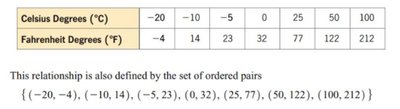
The relationship between Celsius and Fahrenheit temperatures is a function. It can be represented as a table, a set of ordered pairs, or an equation.
Celsius Degrees (°C) | Fahrenheit Degrees (°F) |
|---|---|
-20 | -4 |
-10 | 14 |
-5 | 23 |
0 | 32 |
25 | 77 |
50 | 122 |
100 | 212 |
The conversion formula is:
Example: Blood Alcohol Percent
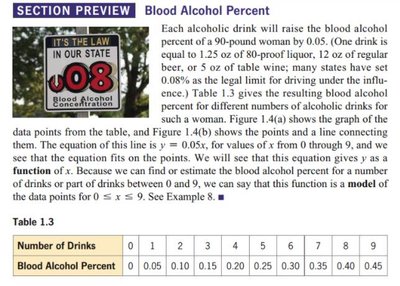
Each alcoholic drink increases the blood alcohol percent of a 90-pound woman by 0.05. This relationship is a function, and can be modeled by the equation , where is the number of drinks and is the blood alcohol percent.
Number of Drinks | Blood Alcohol Percent |
|---|---|
0 | 0.00 |
1 | 0.05 |
2 | 0.10 |
3 | 0.15 |
4 | 0.20 |
5 | 0.25 |
6 | 0.30 |
7 | 0.35 |
8 | 0.40 |
9 | 0.45 |
Function Notation and Evaluation
Function Notation
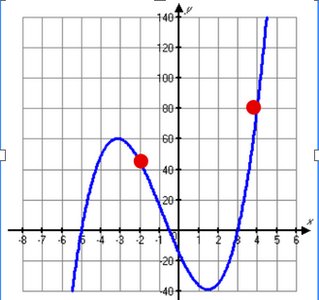
Functions are often written using notation such as , which means "the output of function f for input x." To evaluate a function, substitute the input value into the equation.
Example: If , then and can be found by substituting and into the equation.

Functions as Models
Using Functions to Model Data
Functions can be used to model real-world data, such as the relationship between the number of drinks and blood alcohol percent, or between Celsius and Fahrenheit temperatures. A function is a model if it accurately represents the data.
Example: The function models the blood alcohol percent for a 90-pound woman.
Example: The function models the conversion between Celsius and Fahrenheit.
Applications of Functions
Financial Models: Mortgage Payments
Functions can describe financial relationships, such as the number of years required to pay off a mortgage based on the loan amount. The table below shows the relationship between the mortgage amount and the number of years to pay off the loan at a fixed monthly payment and interest rate.
Amount A ($) | t (years) |
|---|---|
40,000 | 5 |
69,000 | 10 |
89,000 | 15 |
103,000 | 20 |
120,000 | 30 |
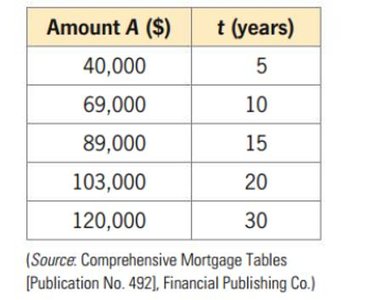
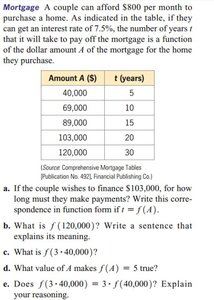
Example: If a couple finances $103,000, they will make payments for 20 years.
Function notation: where is the mortgage amount.
Summary Table: Types of Function Representations
Representation | Description | Example |
|---|---|---|
Table | Lists input-output pairs | Blood alcohol percent table |
Graph | Visual plot of function | Graph of |
Equation | Algebraic formula | |
Ordered pairs | Set of (input, output) pairs | {(-20, -4), (0, 32), (100, 212)} |
Key Concepts
Functions describe relationships between inputs and outputs.
Functions can be represented in multiple ways: tables, graphs, equations, and ordered pairs.
Function notation () is used to evaluate and describe functions.
Functions are used to model real-world data and solve practical problems.
Examples and Applications
Temperature conversion: Use the formula to convert Celsius to Fahrenheit.
Blood alcohol percent: Use to estimate blood alcohol percent based on number of drinks.
Mortgage payments: Use tables and function notation to determine payment periods for different loan amounts.
Additional info: Academic context was added to clarify the definition of functions, function notation, and the use of functions as models in real-world applications.
