 Back
Functions and Their Domains: College Algebra Study Notes
Study Guide - Smart Notes
 Tailored notes based on your materials, expanded with key definitions, examples, and context.
Functions and Their Domains
Introduction to Functions
Functions are fundamental objects in algebra that relate each input to a unique output. Understanding how to describe and analyze functions is essential for solving equations and modeling real-world phenomena.
Definition: A function is a relation that assigns each input (from the domain) exactly one output (from the range).
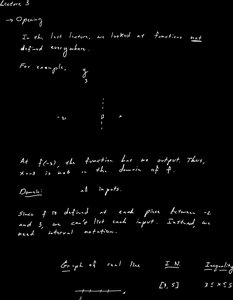
Example: The function \( f(x) = \frac{1}{x} \) assigns to each input \( x \) (except where undefined) a unique output.
Domain of a Function
The domain of a function is the set of all possible input values (usually denoted as \( x \)) for which the function is defined. Determining the domain is a crucial step in analyzing functions.
Key Point: The domain consists of all values for which the function produces a valid output.
Interval Notation: Domains are often described using interval notation, e.g., \( [2,5] \).
Example: For \( f(x) = \frac{1}{x} \), \( x = 0 \) is not in the domain because division by zero is undefined.

Finding Domains Using Trouble Points
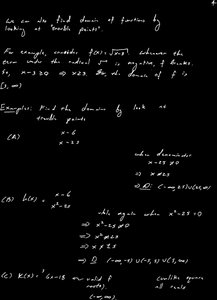
To find the domain of a function, identify values that cause the function to be undefined, such as division by zero or taking the square root of a negative number.
Example 1: \( f(x) = \sqrt{x-3} \) is defined when \( x-3 \geq 0 \), so the domain is \( x \geq 3 \) or \( [3, \infty) \).
Example 2: \( h(x) = \frac{1}{x^2-6x+8} \) is undefined when \( x^2-6x+8 = 0 \). Solve for \( x \): So, \( x = 4 \) or \( x = 2 \). The domain is all real numbers except \( x = 2 \) and \( x = 4 \).
Example 3: \( k(x) = \text{any real number} \) (e.g., \( k(x) = x^2 \)), domain is all real numbers \( (-\infty, \infty) \).
Graphical Representation and Manipulation of Functions
Functions can be represented graphically, and understanding how to manipulate these graphs is important for visualizing algebraic relationships. Shifting, stretching, and reflecting graphs are common transformations.
Key Point: Shifting the graph of a function involves moving it horizontally or vertically.
Example: The graph of \( y = |x| \) can be shifted to the right by replacing \( x \) with \( x - h \), resulting in \( y = |x - h| \).
Application: Manipulating graphs helps in solving equations and understanding function behavior.
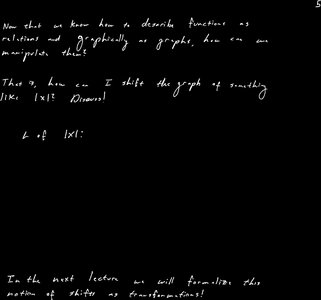
Additional info: In the next lecture, the concept of shifting will be formalized as transformations, which include translations, reflections, and dilations of function graphs.
