 Back
Functions and Their Properties: Definitions, Operations, and Transformations
Study Guide - Smart Notes
 Tailored notes based on your materials, expanded with key definitions, examples, and context.
Functions and Relations
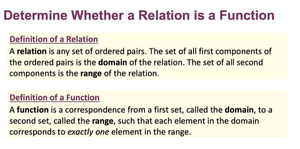
Definition of a Relation
A relation is any set of ordered pairs. The set of all first components of the ordered pairs is called the domain of the relation, and the set of all second components is called the range of the relation.
Definition of a Function
A function is a correspondence from a first set, called the domain, to a second set, called the range, such that each element in the domain corresponds to exactly one element in the range. This means that for every input, there is a unique output.
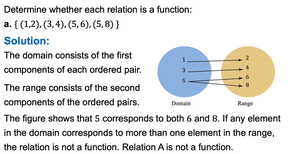
Determining Whether a Relation is a Function
If any element in the domain corresponds to more than one element in the range, the relation is not a function.
If every element in the domain corresponds to exactly one element in the range, the relation is a function.
Functions as Equations
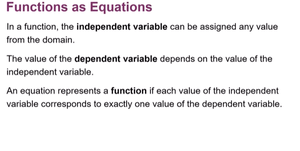
In a function, the independent variable can be assigned any value from the domain. The value of the dependent variable depends on the value of the independent variable. An equation represents a function if each value of the independent variable corresponds to exactly one value of the dependent variable.
Domain and Range
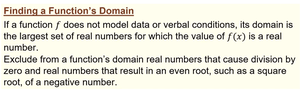
Finding a Function's Domain
The domain of a function is the largest set of real numbers for which the value of the function is a real number. Exclude from the domain any real numbers that cause division by zero or result in an even root (such as a square root) of a negative number.
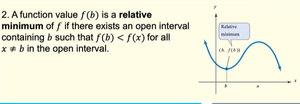
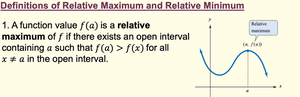
Relative Maximum and Minimum
Definitions
Relative Maximum: A function value is a relative maximum if there exists an open interval containing such that for all in the interval.
Relative Minimum: A function value is a relative minimum if there exists an open interval containing such that for all in the interval.
Piecewise Defined Functions
Definition and Application
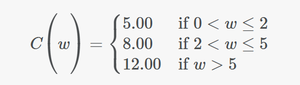
A piecewise function uses different formulas for different parts of its domain. These are commonly used to model real-world situations where a rule changes at certain points, such as tax brackets or shipping costs.
Example: A shipping cost function depending on the weight :
Algebraic Operations on Functions
Sum, Difference, Product, and Quotient
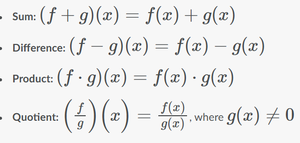
Functions can be combined using algebraic operations. The domain of the new function is the intersection of the domains of the original functions, with the additional restriction that the denominator cannot be zero for quotients.
Sum:
Difference:
Product:
Quotient:
Composition of Functions
Definition and Example
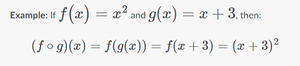
Function composition is the process of applying one function to the result of another. The notation means .
Example: If and , then:
Transformations of Functions
Shifts, Reflections, Stretches, and Shrinks
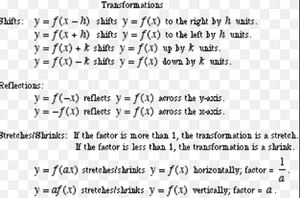
Transformations change the position or shape of a function's graph. Common transformations include:
Shifts: shifts right by units; shifts left by $h$ units; shifts up by units; shifts down by $k$ units.
Reflections: reflects across the y-axis; reflects across the x-axis.
Stretches/Shrinks: stretches/shrinks horizontally (factor ); stretches/shrinks vertically (factor ).
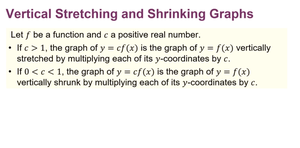
Vertical Stretching and Shrinking
If , the graph of is vertically stretched by multiplying each y-coordinate by . If , the graph is vertically shrunk by multiplying each y-coordinate by $c$.
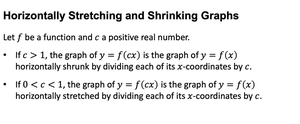
Horizontal Stretching and Shrinking
If , the graph of is horizontally shrunk by dividing each x-coordinate by . If , the graph is horizontally stretched by dividing each x-coordinate by $c$.
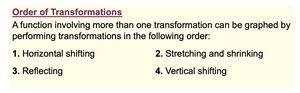
Order of Transformations
When performing multiple transformations, the recommended order is:
Horizontal shifting
Stretching and shrinking
Reflecting
Vertical shifting
Summary Table: Algebraic Operations on Functions
Operation | Notation | Formula | Domain Restriction |
|---|---|---|---|
Sum | Intersection of domains of and | ||
Difference | Intersection of domains of and | ||
Product | Intersection of domains of and | ||
Quotient | Intersection of domains of and , |
