 Back
BackFunctions: Definitions, Properties, and Applications
Study Guide - Smart Notes
 Tailored notes based on your materials, expanded with key definitions, examples, and context.
Functions and Relations
Definition and Concept of a Function
A function is a mathematical rule that assigns to each element in a set, called the domain, exactly one element in another set, called the range. Functions are used to describe how one quantity depends on another, such as production cost depending on items produced or velocity depending on time.
Mapping: Each element in the domain is mapped to one and only one element in the range.
Rule: The function's rule is the method or formula used for assigning values.
Domain: The set of input values.
Range: The set of output values.
Examples of functions in real life:
Production cost as a function of items produced
Revenue as a function of items sold
Blue book value of a car as a function of odometer reading
Velocity of a car as a function of time
Functions vs. Relations
A relation is a set of ordered pairs. Every function is a relation, but not every relation is a function. A function is a relation in which no two ordered pairs have the same first coordinate and different second coordinates.
Function: {(−1, 2), (0, 5), (2, 6), (4, 5)} is a function because each input has only one output.
Not a function: {(−3, 2), (1, −1), (0, 3), (1, 2)} is not a function because the input 1 maps to both −1 and 2.
Graphical Identification of Functions
Vertical Line Test
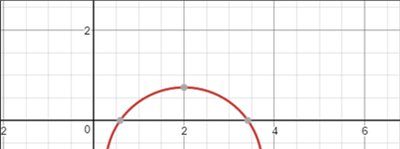
The Vertical Line Test is a graphical method to determine if a relation is a function. A graph represents a function if and only if no vertical line crosses the graph more than once.
If a vertical line intersects the graph at more than one point, the relation is not a function.
If every vertical line intersects the graph at most once, the relation is a function.
Example: The graph below can be analyzed using the vertical line test to determine if it represents a function.
Identifying Functions from Equations
Equations and Functions
Not all equations in two variables define functions. To determine if an equation defines y as a function of x, check if each x-value corresponds to only one y-value.
Example: is not a function because for some x-values, there are two possible y-values.
Example: is a function because each x-value yields only one y-value.
Example: is not a function because some x-values correspond to two y-values.
Example: is not a function for the same reason.
Domain and Range
Definitions
The domain of a relation is the set of all first coordinates (inputs), and the range is the set of all second coordinates (outputs).
Example: For the relation {(−1, 2), (0, 5), (2, 6), (4, 5)}, the domain is {−1, 0, 2, 4} and the range is {2, 5, 6}.
Example: For the relation {(-1,1), (3,9), (3,-9)}, the domain is {−1, 3} and the range is {1, 9, −9}. This is not a function because 3 maps to both 9 and −9.
When using equations to define functions, the domain is often assumed to be all real numbers for which the expression is defined (implied domain).
Undefined expressions: Division by zero and even roots of negative numbers.
Example: Find the domain of : The domain excludes and .
Example: Find the domain of : The domain is .
Function Notation and Evaluation
Function Notation
Functions are often written using special notation. Instead of , we write . The variable is a placeholder for values in the domain.
Example:
The variable is called a "dummy" variable.
Evaluating Functions
To evaluate a function for a specific value, substitute the value into the function's rule.
Example:
Example with a set of ordered pairs: Let
is undefined (0 is not in the domain).
When , .
