 Back
Graphing Techniques in College Algebra: Transformations, Symmetry, and Function Properties
Study Guide - Smart Notes
 Tailored notes based on your materials, expanded with key definitions, examples, and context.
Graphing Techniques
Stretching and Shrinking
Graph transformations such as stretching and shrinking alter the shape of a function's graph by changing its steepness or width. These transformations can be vertical or horizontal, depending on how the function is modified.
Vertical Stretching: If a function is multiplied by a constant a where a > 1, the graph is stretched vertically. Each y-value is multiplied by a.
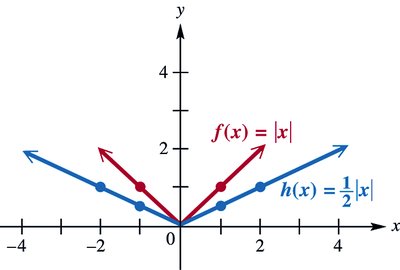
Vertical Shrinking: If 0 < a < 1, the graph is shrunk vertically. Each y-value is multiplied by a.
Horizontal Stretching: If the input variable x is multiplied by a constant a where 0 < a < 1, the graph is stretched horizontally.
Horizontal Shrinking: If a > 1, the graph is shrunk horizontally.
Formula: (vertical stretch/shrink) (horizontal stretch/shrink) Example: The graph of is a vertical stretch of by a factor of 2. 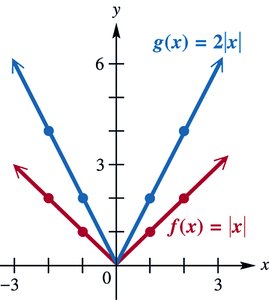 Example: The graph of is a vertical shrink of by a factor of 1/2.
Reflecting
Reflection creates a mirror image of a graph across a specified axis. There are two main types:
Reflection across the x-axis: The graph of is the reflection of across the x-axis. Each y-value is multiplied by -1.
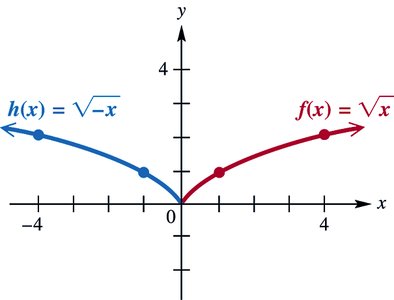
Reflection across the y-axis: The graph of is the reflection of across the y-axis. Each x-value is replaced by its opposite.
Example: The graph of is the reflection of across the x-axis. 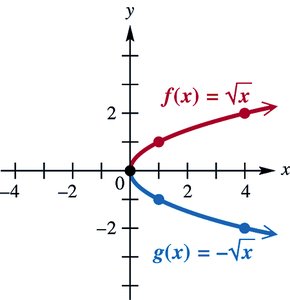 Example: The graph of is the reflection of across the y-axis.
Symmetry
Symmetry in graphs helps identify patterns and properties of equations. There are three main types:
y-axis Symmetry: The graph is unchanged when x is replaced by -x. Indicates an even function.
x-axis Symmetry: The graph is unchanged when y is replaced by -y. (Note: Such graphs do not represent functions.)
Origin Symmetry: The graph is unchanged when both x and y are replaced by -x and -y, respectively. Indicates an odd function.
Example: The graph of is symmetric with respect to the y-axis. 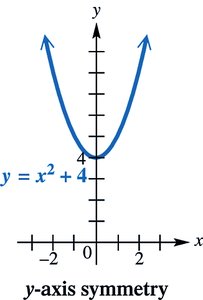 Example: The graph of has no x-axis or y-axis symmetry.
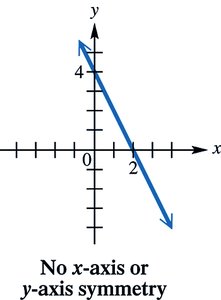
Even and Odd Functions
Functions can be classified based on their symmetry:
Even Function: for all x in the domain. The graph is symmetric with respect to the y-axis.
Odd Function: for all x in the domain. The graph is symmetric with respect to the origin.
Neither: If neither condition is satisfied, the function is neither even nor odd.
Translations
Translations shift the graph of a function without changing its shape. There are two main types:
Vertical Translation: Adding or subtracting a constant k to a function shifts the graph up or down.
Horizontal Translation: Adding or subtracting a constant h inside the function argument shifts the graph left or right.
Formulas: (vertical translation) (horizontal translation) Example: The graph of is a vertical translation of downward by 4 units. 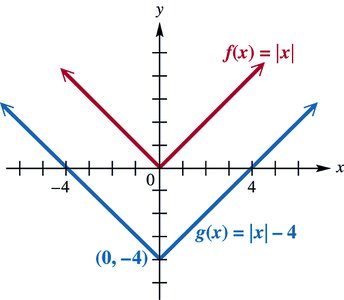 Example: The graph of is a vertical translation of up by 2 units; is a translation down by 3 units.
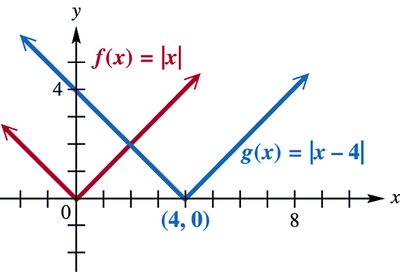
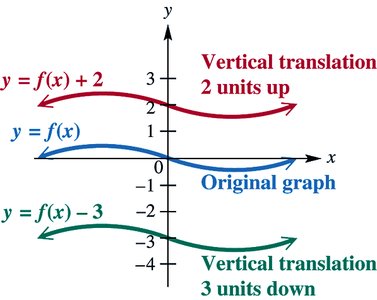 Example: The graph of is a horizontal translation of right by 4 units.
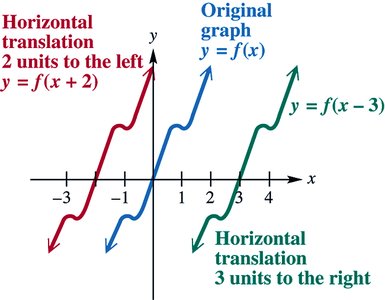
 Example: The graph of is a horizontal translation of left by 2 units; is a translation right by 3 units.
Multiple Transformations
Functions can undergo several transformations simultaneously, such as stretching, reflecting, and translating. The order of operations can affect the final graph.
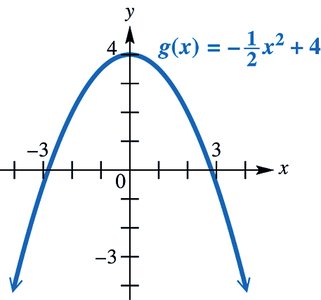
Example: The graph of involves a reflection across the x-axis, a horizontal translation left by 3 units, and a vertical translation up by 1 unit. 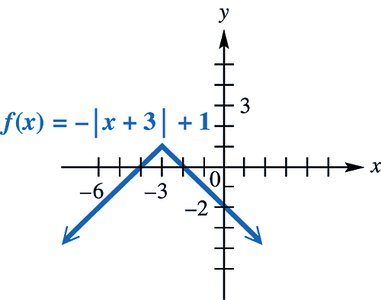 Example: The graph of involves a vertical shrink by 1/2, reflection across the x-axis, and a vertical translation up by 4 units.
Summary Table: Types of Symmetry
Symmetry Type | Test | Example |
|---|---|---|
y-axis | Replace x with -x | |
x-axis | Replace y with -y | |
Origin | Replace x with -x and y with -y |
Summary of Graphing Techniques
The graph of is translated k units up.
The graph of is translated k units down.
The graph of is translated h units to the left.
The graph of is translated h units to the right.
The graph of is a vertical stretching if and a vertical shrinking if .
The graph of is a horizontal shrinking if and a horizontal stretching if .
The graph of is reflected across the x-axis.
The graph of is reflected across the y-axis.
Graphing Translations and Reflections of a Given Graph
Given a base graph , you can apply the above transformations to sketch new graphs. For example:
shifts the graph up by 3 units.
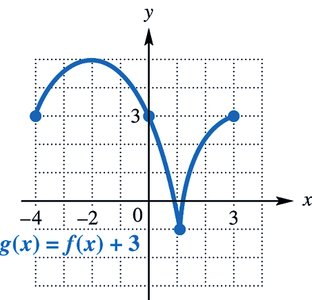
shifts the graph left by 3 units.
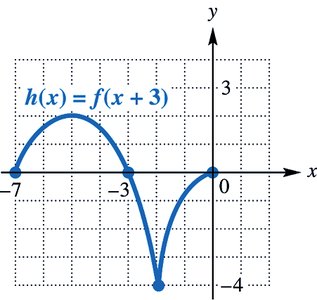
shifts the graph right by 2 units and up by 3 units.
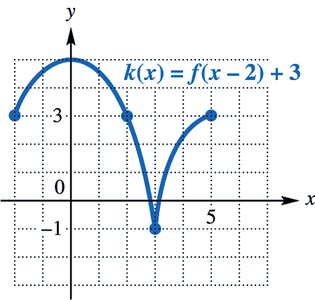
reflects the graph across the x-axis.
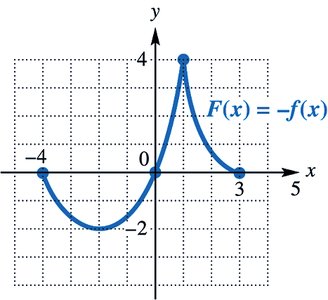
Additional info: Understanding these transformations is essential for analyzing and sketching the graphs of algebraic functions, which is a foundational skill in College Algebra.
