Back
BackInverse, Exponential, and Logarithmic Functions: Study Notes
Study Guide - Smart Notes
 Tailored notes based on your materials, expanded with key definitions, examples, and context.
Inverse, Exponential, and Logarithmic Functions
Introduction to Exponential Functions
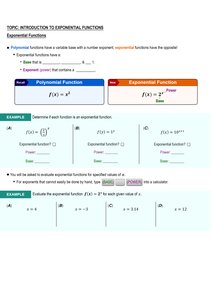
Exponential functions are a fundamental class of functions in algebra where the variable appears in the exponent. These functions model rapid growth or decay and are widely used in science, finance, and engineering.
Definition: An exponential function has the form , where and .
Key Feature: The base is a constant, and the exponent is the variable .
Contrast: In a polynomial function, the variable is the base and the exponent is a constant.
Polynomial Function | Exponential Function |
|---|---|
Example: is exponential; is polynomial.
Graphs of Exponential Functions
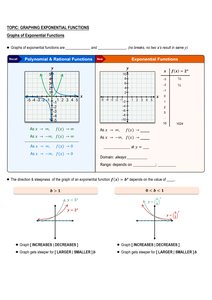
The graph of an exponential function depends on the value of :
If , the function increases rapidly as increases.
If , the function decreases as increases.
Domain:
Range:
Horizontal Asymptote:
Transformations of Exponential Graphs
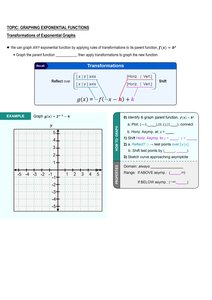
Exponential graphs can be transformed by shifting, reflecting, stretching, or compressing the parent function .
General Transformation:
Horizontal Shift: units right if , left if
Vertical Shift: units up if , down if
Reflection: Over the -axis if multiplied by
Graphing Exponential Functions: Examples and Practice
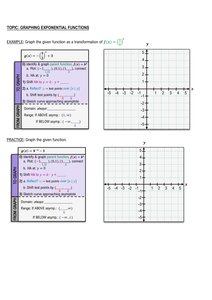
To graph a transformed exponential function, identify the parent function, apply shifts and reflections, and plot key points.
Example: Graph as a transformation of .
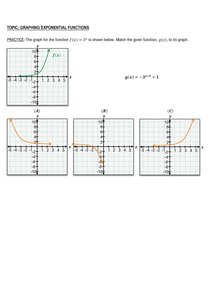
Practice: Graph and match to its graph.
The Number e
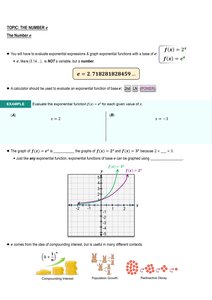
The number is an important mathematical constant approximately equal to 2.71828. Exponential functions with base $e$ are called natural exponential functions.
Definition:
Applications: Compound interest, population growth, radioactive decay
Graphing Exponential Functions with Base e
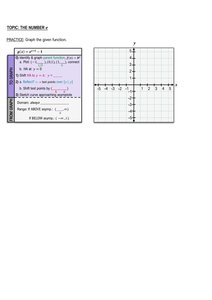
Graphing follows the same principles as other exponential functions. The domain is all real numbers, and the range is positive real numbers.
Identify the horizontal asymptote at .
Plot key points such as and .
Introduction to Logarithms
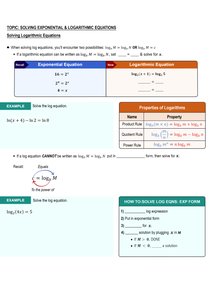
Logarithms are the inverse operations of exponentiation. The logarithm of a number is the exponent to which the base must be raised to produce that number.
Definition: means
Common Bases: (common log), (natural log, written )
Exponential Form | Logarithmic Form |
|---|---|
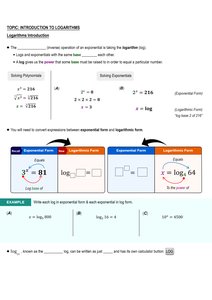
Evaluating Logarithms and Properties
Logarithms can be evaluated using properties that relate them to exponents.
Product Rule:
Quotient Rule:
Power Rule:
Change of Base:
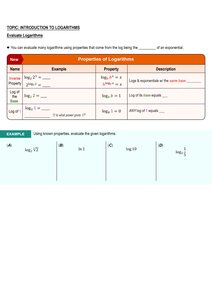
Graphs of Logarithmic Functions
The graph of a logarithmic function is the inverse of the exponential function .
Domain:
Range:
Vertical Asymptote:
Graph increases if , decreases if
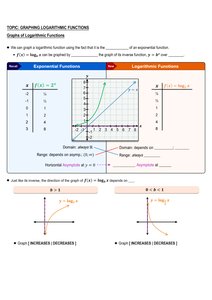
Transformations of Logarithmic Graphs
Logarithmic graphs can be shifted, reflected, and stretched using transformations similar to those for exponential functions.
General Transformation:
Apply horizontal and vertical shifts, and reflections as needed.
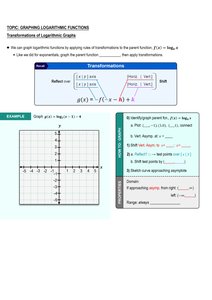
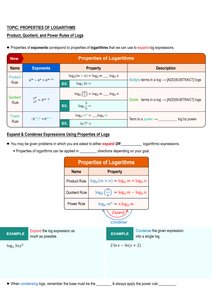
Properties of Logarithms: Product, Quotient, and Power Rules
Properties of logarithms allow for the expansion and condensation of logarithmic expressions, which is useful for solving equations and simplifying expressions.
Property | Rule | Description |
|---|---|---|
Product | Log of a product is the sum of logs | |
Quotient | Log of a quotient is the difference of logs | |
Power | Log of a power is the exponent times the log |
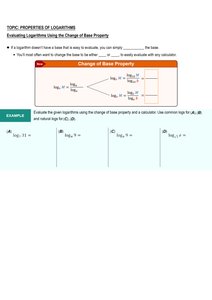
Change of Base Property
The change of base property allows you to evaluate logarithms with any base using a calculator.
Formula: , where is any positive value (commonly 10 or )
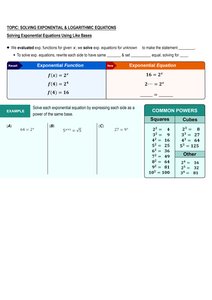
Solving Exponential Equations
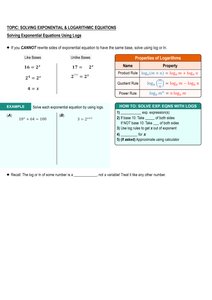
Exponential equations can be solved by expressing both sides with the same base or by using logarithms.
Same Base: If possible, rewrite both sides with the same base and set exponents equal.
Using Logs: If not possible, take the logarithm of both sides and solve for the variable.
Solving Logarithmic Equations
Logarithmic equations can be solved by rewriting in exponential form or by using properties of logarithms to combine terms.
Isolate the logarithmic expression if possible.
Rewrite the equation in exponential form to solve for the variable.
Check for extraneous solutions, especially if the argument of the log must be positive.