 Back
BackInverse Functions and Their Representations
Study Guide - Smart Notes
 Tailored notes based on your materials, expanded with key definitions, examples, and context.
Inverse Functions and Their Representations
Definition of Inverse Functions
An inverse function reverses the effect of the original function. If f is a function with domain A and range B, then its inverse, denoted f-1, satisfies:
f(f-1(x)) = x for every x in the domain of f-1
f-1(f(x)) = x for every x in the domain of f
Domain of f: Set of all possible input values for f. Range of f: Set of all possible output values for f. Domain of f-1: Range of f. Range of f-1: Domain of f.
To find f-1(x), solve the equation y = f(x) for x and then interchange x and y.
Finding Inverse Functions Algebraically
To find the inverse of a function:
Replace f(x) with y.
Solve the equation for x.
Replace x with y and y with x to write f-1(x).
Example: Find the inverse of f(x) = 2x + 1.
Let y = 2x + 1
Solve for x: y - 1 = 2x → x = (y - 1)/2
Interchange x and y: y = (x - 1)/2
So, f-1(x) = (x - 1)/2
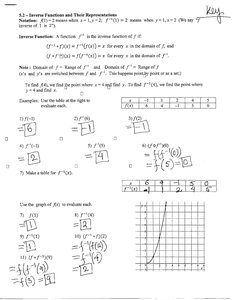
Evaluating Inverse Functions
To evaluate f-1(a), find the value x such that f(x) = a. This can be done using a table or a graph of the function.
Use the table of values for f(x) to find the corresponding x for a given output.
Use the graph of f(x) to locate the point where y = a and read the corresponding x-value.
Graphing Inverse Functions
Symmetry and Graphical Representation
The graph of a function and its inverse are symmetric with respect to the line y = x. To graph the inverse, reflect the graph of f(x) across the line y = x.
The domain of f becomes the range of f-1 and vice versa.
Key points (a, b) on f(x) become (b, a) on f-1(x).
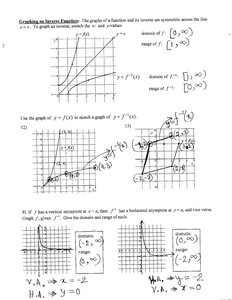
Horizontal and Vertical Asymptotes
If f(x) has a vertical asymptote at x = a, then f-1(x) has a horizontal asymptote at y = a, and vice versa.
Vertical asymptote: The function approaches but never crosses a specific x-value.
Horizontal asymptote: The function approaches but never crosses a specific y-value.
Solving for the Inverse Function
Step-by-Step Process
To solve for the inverse function algebraically:
Replace f(x) with y.
Solve for x in terms of y.
Interchange x and y to write the inverse function.
Example: Find the inverse of f(x) = (3x - 1)/2.
Let y = (3x - 1)/2
2y = 3x - 1 → 3x = 2y + 1 → x = (2y + 1)/3
Interchange x and y: y = (2x + 1)/3
So, f-1(x) = (2x + 1)/3
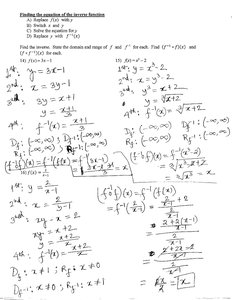
Domain and Range of Inverse Functions
The domain of the inverse function is the range of the original function, and the range of the inverse is the domain of the original function.
Always state the domain and range for both f(x) and f-1(x).
One-to-One Functions and the Horizontal Line Test
Definition of One-to-One Functions
A function is one-to-one if each output value corresponds to exactly one input value. This property is necessary for a function to have an inverse that is also a function.
If different inputs produce the same output, the function is not one-to-one and does not have an inverse function.
Horizontal Line Test
If any horizontal line intersects the graph of a function more than once, the function is not one-to-one and does not have an inverse function.
Use the horizontal line test to determine if a function is invertible.
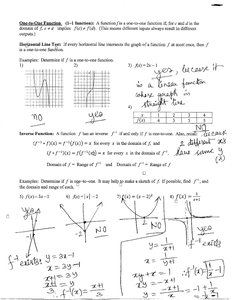
Examples and Applications
Linear functions (e.g., f(x) = 2x + 1) are one-to-one and have inverses.
Quadratic functions (e.g., f(x) = x2) are not one-to-one unless their domain is restricted.
Example: For f(x) = x2, restrict the domain to x ≥ 0 to make it one-to-one and find the inverse: f-1(x) = √x.
Additional info: The notes also include worked examples, tables, and graphs to reinforce the concepts of inverse functions, their domains and ranges, and graphical symmetry. The images provided are directly relevant to the explanations and illustrate key concepts such as finding inverses, evaluating them, and using the horizontal line test.
