 Back
BackKey Concepts in Complex Numbers, Completing the Square, and Slopes of Lines
Study Guide - Smart Notes
 Tailored notes based on your materials, expanded with key definitions, examples, and context.
Complex Numbers and Their Classification
Overview of Complex Numbers
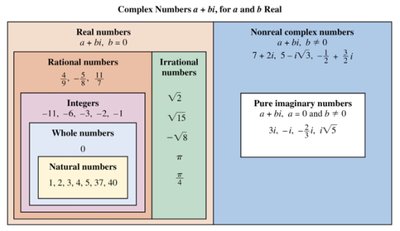
Complex numbers are numbers of the form a + bi, where a and b are real numbers and i is the imaginary unit defined by i = \sqrt{-1}. The set of complex numbers includes both real and nonreal numbers, expanding the number system to solve equations that have no real solutions.
Real numbers: Numbers where b = 0 (e.g., 5, -3, 0, \frac{2}{3}, \sqrt{2})
Nonreal complex numbers: Numbers where b \neq 0 (e.g., 7 + 2i, 5 - i\sqrt{3})
Pure imaginary numbers: Numbers where a = 0 and b \neq 0 (e.g., 3i, -i, \frac{3}{4}i)
Subsets of Real Numbers
Natural numbers: Counting numbers (1, 2, 3, ...)
Whole numbers: Natural numbers and zero (0, 1, 2, ...)
Integers: Whole numbers and their negatives (..., -2, -1, 0, 1, 2, ...)
Rational numbers: Numbers that can be written as a fraction of integers (\frac{3}{4}, -2, 0.5)
Irrational numbers: Numbers that cannot be written as a simple fraction (\sqrt{2}, \pi)
Solving Quadratic Equations by Completing the Square
Step-by-Step Method
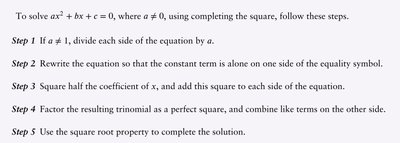
Completing the square is a systematic method for solving quadratic equations of the form ax^2 + bx + c = 0 (where a \neq 0). This method rewrites the quadratic in a form that allows the use of the square root property.
If a \neq 1, divide both sides of the equation by a.
Rewrite the equation so that the constant term is alone on one side of the equality symbol.
Square half the coefficient of x, and add this square to each side of the equation.
Factor the resulting trinomial as a perfect square, and combine like terms on the other side.
Use the square root property to complete the solution.
Slopes of Lines
Types of Slopes
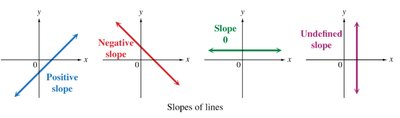
The slope of a line describes its steepness and direction. It is calculated as the ratio of the change in y to the change in x between two points on the line.
Positive slope: Line rises from left to right.
Negative slope: Line falls from left to right.
Slope 0: Horizontal line.
Undefined slope: Vertical line.
The formula for the slope m between two points (x_1, y_1) and (x_2, y_2) is:
Piecewise Functions and Graphs
Understanding Piecewise Functions
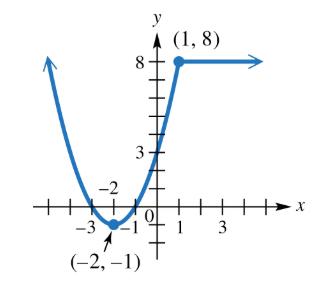
A piecewise function is defined by different expressions for different intervals of the domain. The graph of a piecewise function may have distinct segments, each corresponding to a different formula.
Pay attention to open and closed circles on the graph, which indicate whether endpoints are included in the interval.
Check for continuity at the points where the formula changes.
Summary Table: Complex Numbers and Their Subsets
Set | Definition | Examples |
|---|---|---|
Natural Numbers | Counting numbers | 1, 2, 3, ... |
Whole Numbers | Natural numbers and zero | 0, 1, 2, ... |
Integers | Whole numbers and negatives | -2, -1, 0, 1, 2 |
Rational Numbers | Fractions of integers | \frac{3}{4}, -2, 0.5 |
Irrational Numbers | Cannot be written as a fraction | \sqrt{2}, \pi |
Pure Imaginary Numbers | Numbers of the form bi, b \neq 0 | 3i, -i, \frac{3}{4}i |
Nonreal Complex Numbers | Numbers with both real and imaginary parts | 7 + 2i, 5 - i\sqrt{3} |
