 Back
BackLinear and Absolute Value Inequalities: Study Guide
Study Guide - Smart Notes
 Tailored notes based on your materials, expanded with key definitions, examples, and context.
Section 1.7: Linear and Absolute Value Inequalities
Introduction to Inequalities
An inequality is a mathematical statement indicating that two algebraic expressions are not equal in a specific way. Inequalities use symbols such as <, ≤, >, and ≥ to compare values. The solution set for an inequality consists of all real numbers for which the inequality holds true, often represented as intervals or unions/intersections of intervals.
Key Point: Inequalities describe ranges of values rather than single values.
Key Point: Solution sets are commonly written in interval notation.
Example: For , the solution set is .
Interval Notation for Inequalities
Interval notation is used to express the set of solutions for inequalities. The notation indicates whether endpoints are included (closed) or excluded (open).
Unbounded, open:
Unbounded, closed:
Unbounded, open:
Unbounded, closed:
Bounded, open:
Bounded, half-open/closed:
Bounded, half-open/closed:
Bounded, closed:
All real numbers:
Equivalent Inequalities
Two inequalities are equivalent if they have the same solution set. Equivalent inequalities can be produced by performing the same operation on both sides, provided the operation does not change the direction of the inequality (unless multiplying or dividing by a negative number).
Add/Subtract:
Multiply/Divide by positive: (for )
Multiply/Divide by negative: (for )
Divide: (for ), (for )
Solving Linear Inequalities
To solve linear inequalities, isolate the variable using algebraic operations, remembering to reverse the inequality sign when multiplying or dividing by a negative number.
Example: Solve
Example: Solve
Compound Inequalities
A compound inequality contains two simple inequalities connected by "and" or "or". The solution set may be an intersection or union of intervals.
Intersection (and): means all elements in both sets.
Union (or): means all elements in either set.
Example: Let , , - - - (empty set)
Example: Solve and
Example: Solve or
Absolute Value Inequalities
The absolute value of a number is its distance from zero on the number line. Absolute value inequalities can be transformed into compound inequalities.
Key Point: means
Key Point: means or
Example: Solve
Example: Solve
Special Cases in Absolute Value Inequalities
When the right side of an absolute value inequality is zero or negative, special cases arise:
: No solution, since absolute value is always non-negative.
: All real numbers, since absolute value is always greater than or equal to zero.
: All real numbers.
: Only .
Summary Table: Basic Absolute Value Inequalities (for k > 0)
This table summarizes the forms, equivalent statements, solution sets, and graphical representations of basic absolute value inequalities.
Absolute value inequality | Equivalent statement | Solution set in interval notation | Graph of solution set |
|---|---|---|---|
or |
| ||
or | See image above | ||
See image above | |||
See image above |
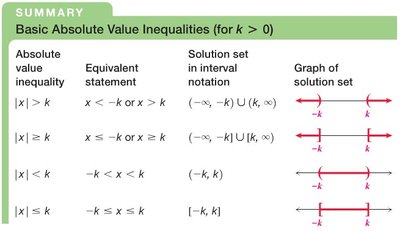
Solving Absolute Value Inequalities: Examples
Example: Solve - Equivalent: - Solution: - Interval notation:
Example: Solve - Since , all real numbers are solutions.
Additional info: Compound inequalities and absolute value inequalities are foundational for understanding more advanced algebraic concepts, including systems of inequalities and modeling real-world situations.
