 Back
BackLinear and Rational Equations: College Algebra Study Guide
Study Guide - Smart Notes
 Tailored notes based on your materials, expanded with key definitions, examples, and context.
Linear and Rational Equations
Linear Equations
Linear equations are fundamental in algebra and represent relationships where the highest power of the variable is one. They can be solved algebraically or graphically, and are often used to model real-world situations.
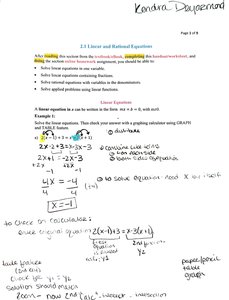
Definition: A linear equation is an equation of the form ax + b = 0, where a and b are constants and x is the variable.
Solving Linear Equations: To solve for x, isolate the variable using algebraic operations such as addition, subtraction, multiplication, and division.
Example: Solve Steps: 1. Move all terms involving x to one side: 2. Simplify: 3. Divide by -1:
Checking Solutions: Substitute the solution back into the original equation to verify correctness.
Graphical Solution of Linear Equations
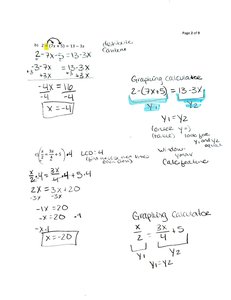
Linear equations can also be solved using a graphing calculator by plotting both sides of the equation as separate functions and finding their intersection.
Graphing Calculator Method: 1. Enter each side of the equation as Y1 and Y2. 2. Find the value of x where Y1 = Y2.
Example: For , enter and .
Rational Equations
Solving Rational Equations
Rational equations involve fractions with variables in the denominator. Solving these equations requires finding a common denominator and eliminating fractions.
Definition: A rational equation is an equation containing one or more rational expressions.
Steps to Solve:
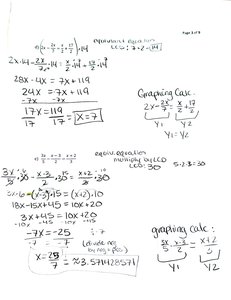
Find the least common denominator (LCD) of all rational expressions.
Multiply both sides of the equation by the LCD to clear denominators.
Solve the resulting linear equation.
Check for extraneous solutions by substituting back into the original equation.
Example: Solve Steps: 1. LCD is 14. 2. Multiply both sides by 14: 3. Rearrange: 4. Simplify: 5.
Checking Solutions and Extraneous Roots
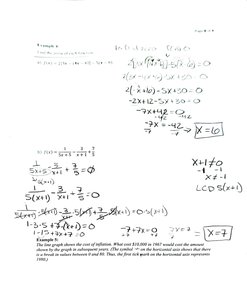
It is important to check solutions to rational equations, as some values may make the denominator zero and are not valid solutions.
Extraneous Solutions: Solutions that do not satisfy the original equation due to division by zero or other restrictions.
Example: If solving , check that and .
Applications of Linear Equations
Modeling with Linear Functions
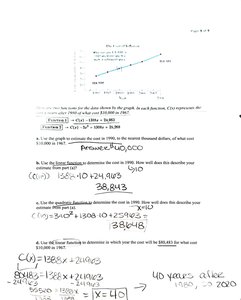
Linear equations are used to model real-world situations, such as predicting costs or population growth. The general form is , where m is the slope and b is the y-intercept.
Example: A cost function models the cost over time. To find the cost in 1990, substitute .
Using the Function:
Graphical Interpretation: The slope represents the rate of change, and the y-intercept represents the initial value.
Summary Table: Linear vs. Rational Equations
Type | Definition | Solving Method | Key Considerations |
|---|---|---|---|
Linear Equation | Equation of the form ax + b = 0 | Isolate x using algebraic operations | Check solution by substitution |
Rational Equation | Equation with variables in denominators | Clear denominators using LCD, solve resulting equation | Check for extraneous solutions |
Additional info: The notes also reference the use of graphing calculators for checking solutions, which is a useful tool for visualizing and verifying algebraic results.
