 Back
BackMath 120 – Unit 3 Exam Review: College Algebra Study Guidance
Study Guide - Smart Notes
 Tailored notes based on your materials, expanded with key definitions, examples, and context.
Q1. Solve the system of equations:
a. \( \begin{cases} \frac{1}{4}y = -x + 2 \\ 3y = x - 3 \end{cases} \)
Background
Topic: Systems of Linear Equations
This question tests your ability to solve a system of two linear equations using either substitution or elimination methods.
Key Terms and Formulas:
System of equations: Two or more equations with the same variables.
Substitution method: Solve one equation for one variable and substitute into the other.
Elimination method: Add or subtract equations to eliminate one variable.
Step-by-Step Guidance
Start by isolating one variable in one of the equations. For example, from the first equation, solve for \( y \) in terms of \( x \): \( \frac{1}{4}y = -x + 2 \)
Multiply both sides by 4 to clear the fraction: \( y = -4x + 8 \)
Substitute this expression for \( y \) into the second equation: \( 3(-4x + 8) = x - 3 \)
Expand and simplify the equation to solve for \( x \).
Try solving on your own before revealing the answer!
Final Answer: (2, 3)
After substituting and solving, you find \( x = 2 \) and \( y = 3 \).
Q2. For the points (1, -4) and (5, 2):
a. Find the distance between the points (simplified radical and decimal form).
b. Find the midpoint of the line segment connecting them.
Background
Topic: Distance and Midpoint Formulas
This question tests your ability to use the distance and midpoint formulas for points in the coordinate plane.
Key Terms and Formulas:
Distance formula:
Midpoint formula:
Step-by-Step Guidance
Label the points: \( (x_1, y_1) = (1, -4) \), \( (x_2, y_2) = (5, 2) \).
Plug the coordinates into the distance formula:
Simplify inside the square root and leave in radical form. Then, calculate the decimal approximation (rounded to the hundredth).
For the midpoint, plug the coordinates into the midpoint formula:
Try solving on your own before revealing the answer!
Final Answer:
Distance: or approximately 7.21 Midpoint: (3, -1)
Q3. Complete the square for the equation and write in standard form. Then, give the center and radius of the circle:
Background
Topic: Circles – Completing the Square
This question tests your ability to rewrite the equation of a circle in standard form by completing the square, and to identify the center and radius.
Key Terms and Formulas:
Standard form of a circle:
Completing the square: Rearranging and adding terms to form perfect square trinomials.
Step-by-Step Guidance
Group the and terms:
Complete the square for terms: Add and subtract inside the equation.
Complete the square for terms: Add and subtract inside the equation.
Rewrite the equation in the form and identify the center and radius .
Try solving on your own before revealing the answer!
Final Answer:
Standard form: Center: (3, -1), Radius: 3
Q4. Using the graph of this circle, write the equation of the circle in standard form.
Background
Topic: Circles – Equation from Graph
This question tests your ability to write the equation of a circle in standard form by identifying the center and radius from its graph.
Key Terms and Formulas:
Standard form of a circle:
Center:
Radius:
Step-by-Step Guidance
From the graph, identify the center of the circle.
Determine the radius by measuring the distance from the center to a point on the circle.
Write the equation in the form using the values found.
Try solving on your own before revealing the answer!
Final Answer:
Q14. Graph the rational function , including vertical asymptotes (if any) sketched as dashed lines.
Background
Topic: Graphing Rational Functions
This question tests your ability to graph a rational function, identify and sketch vertical asymptotes, and understand the behavior of the function near these asymptotes.
Key Terms and Formulas:
Vertical asymptote: A line where the function grows without bound as approaches .
Horizontal asymptote: A line that the function approaches as goes to infinity or negative infinity.
Step-by-Step Guidance
Set the denominator equal to zero to find vertical asymptotes: .
Solve for to find the equations of the vertical asymptotes.
Determine the horizontal asymptote by comparing the degrees of the numerator and denominator.
Plot key points and sketch the graph, showing the behavior near the asymptotes.
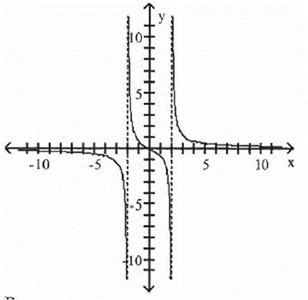
Try solving on your own before revealing the answer!
Final Answer:
Vertical asymptotes at and ; horizontal asymptote at .
