Back
BackOptimization of Weekly Production Using Algebraic Methods
Study Guide - Smart Notes
 Tailored notes based on your materials, expanded with key definitions, examples, and context.
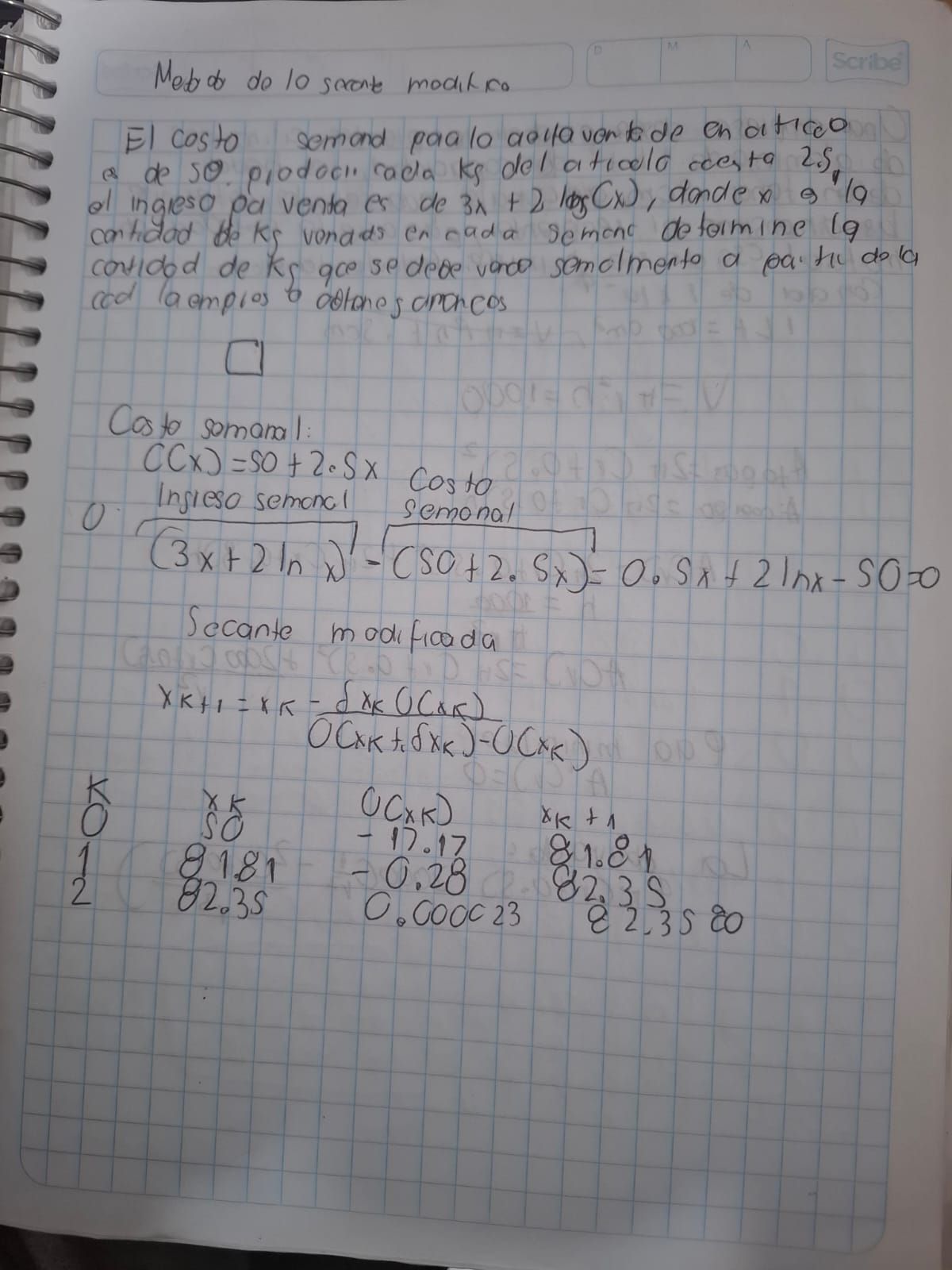
Método de lo Secante Modificado (Modified Secant Method)
Introduction to the Problem
This section presents an application of algebraic modeling and optimization to determine the optimal quantity of a product to maximize profit. The scenario involves calculating weekly costs and revenues for the sale of a chemical product, and using iterative methods to find the optimal production level.
Cost Function (Costo semanal): The weekly cost for producing x kilograms is given by .
Revenue Function (Ingreso semanal): The weekly revenue from selling x kilograms is .
Profit Function (Utilidad semanal): The weekly profit is the difference between revenue and cost: .
Formulating the Optimization Problem
To maximize profit, set the derivative of the profit function to zero and solve for x:
Profit Maximization Condition:
Derivative of Profit Function:
Equation to Solve:
Modified Secant Method for Root Finding
The Modified Secant Method is an iterative numerical technique used to find roots of equations. It is particularly useful when the function is nonlinear and cannot be solved algebraically.
Iteration Formula:
Initial Guesses: Two starting values for x are chosen (e.g., , ).
Convergence: The process is repeated until the difference between successive approximations is sufficiently small.
Example: Iterative Solution Steps
The following table summarizes the iterative process for finding the optimal value of x:
Iteration (k) | x_k | U'(x_k) |
|---|---|---|
0 | 50 | -17.17 |
1 | 81.81 | 0.28 |
2 | 82.35 | 0.00023 |
After a few iterations, the value of x converges to approximately 82.35, which is the optimal weekly production quantity to maximize profit.
Summary Table: Key Functions and Their Roles
Function | Expression | Description |
|---|---|---|
Cost | Weekly production cost | |
Revenue | Weekly sales income | |
Profit | Weekly profit |
Conclusion
This example demonstrates the use of algebraic modeling and iterative numerical methods (such as the Modified Secant Method) to solve optimization problems in business and economics. The approach is widely applicable in college algebra for maximizing or minimizing functions subject to real-world constraints.