Back
BackOptimization of Weekly Production Using Algebraic Modeling
Study Guide - Smart Notes
 Tailored notes based on your materials, expanded with key definitions, examples, and context.
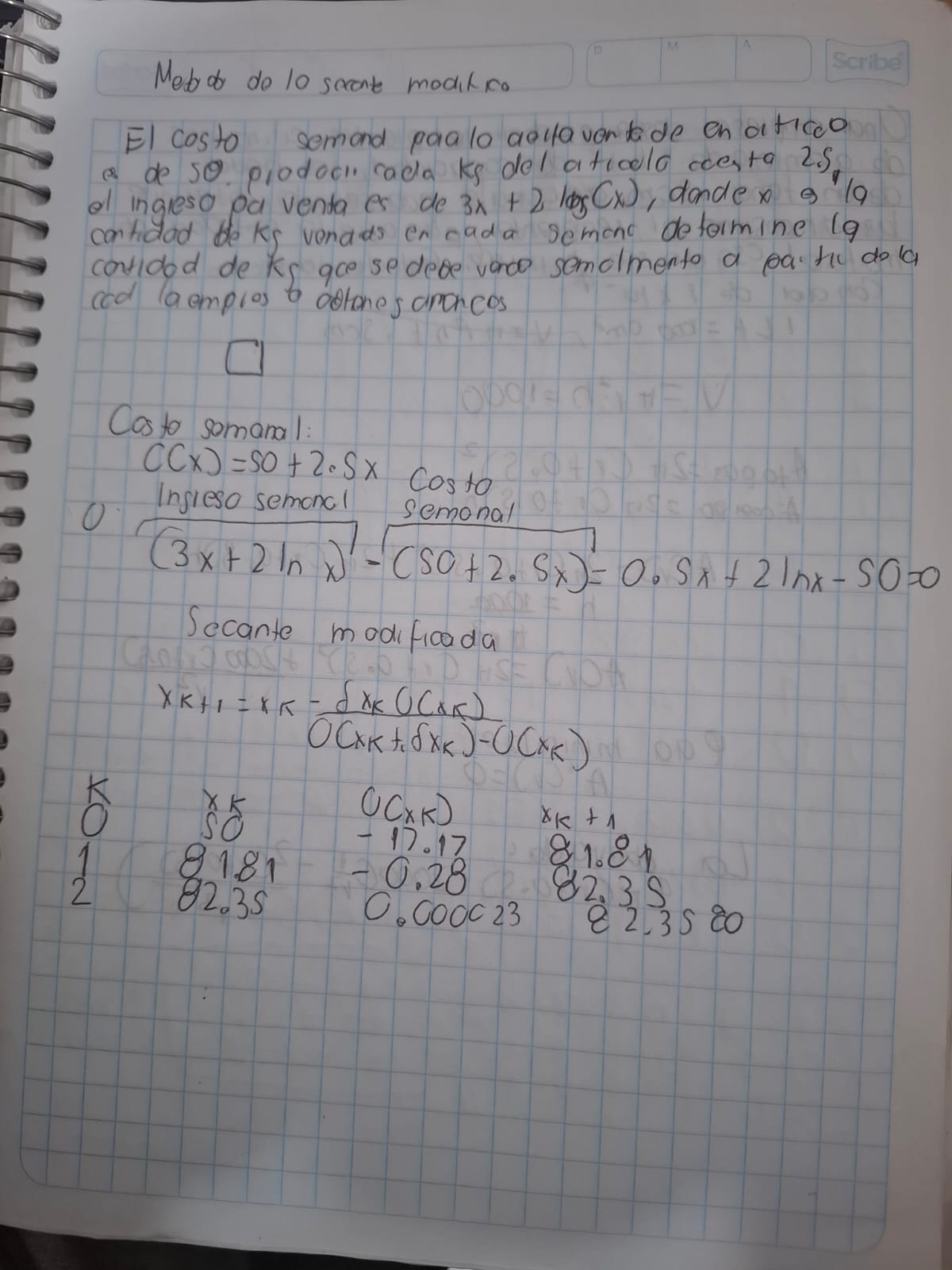
Método de lo secante modificado (Modified Secant Method)
Introduction to the Problem
This study note addresses an optimization problem relevant to college algebra, specifically involving equations, functions, and modeling. The scenario is about determining the optimal weekly production (in kilograms) of a product to maximize profit, given cost and revenue functions.
Cost and Revenue Functions
The weekly cost for producing the product is modeled as a function of the quantity produced:
Cost Function:
Revenue Function:
Where x is the number of kilograms produced and sold each week.
The goal is to determine the value of x that maximizes profit, defined as the difference between revenue and cost.
Profit Function and Optimization
The profit function is given by:
Profit Function:
Simplified:
To find the optimal production, set the profit function's derivative to zero:
Equation to Solve:
This equation is solved using iterative methods, such as the modified secant method.
Modified Secant Method
The modified secant method is an iterative numerical technique used to find roots of equations. The general formula is:
Where is a small increment, and is the function whose root is sought.
Application to the Problem
Applying the method to the profit function:
Let
Initial guess:
Iterations are performed to refine the value of that satisfies .
Iteration Table
The table below summarizes the iterative process:
k | x_k | f(x_k) | x_{k+1} |
|---|---|---|---|
0 | 50 | 0.54 | 81.81 |
1 | 81.81 | 0.28 | 82.35 |
2 | 82.35 | 0.00023 | 82.35 |
After several iterations, the optimal production is approximately 82.35 kg per week.
Example Calculation
Suppose :
Cost:
Revenue:
Profit:
Additional info: The profit is nearly zero, indicating the break-even point.
Summary Table of Iterations
Iteration (k) | x_k | f(x_k) | x_{k+1} |
|---|---|---|---|
0 | 50 | 0.54 | 81.81 |
1 | 81.81 | 0.28 | 82.35 |
2 | 82.35 | 0.00023 | 82.35 |
Conclusion
This example demonstrates the use of algebraic modeling and iterative methods to solve optimization problems, a key topic in college algebra. The modified secant method is a practical tool for finding roots of nonlinear equations when analytical solutions are difficult.