 Back
BackPiecewise-Defined Functions and Average Rate of Change
Study Guide - Smart Notes
 Tailored notes based on your materials, expanded with key definitions, examples, and context.
Piecewise-Defined Functions
Definition and Structure
A piecewise function is a function that is defined by different equations or expressions for different intervals of its domain. This allows the function to exhibit different behaviors in different regions.
Key Point 1: Piecewise functions are written using multiple equations, each with its own domain restriction.
Key Point 2: The overall function is constructed by combining these equations, so that each applies only to its specified interval.
Example:
Let f(x) = \begin{cases} x^2 & \text{if } x < 0 \\ 2x + 1 & \text{if } x \geq 0 \end{cases}
This function uses x2 for negative x-values and 2x+1 for non-negative x-values.
Average Rate of Change
Concept and Calculation
The average rate of change of a function between two points measures how much the function's output changes per unit increase in input. For functions whose graphs are not straight lines, this is equivalent to the slope of the secant line connecting the two points.
Key Point 1: The average rate of change between points a and b is calculated as:
Formula:
Key Point 2: This formula gives the slope of the line passing through the points (a, f(a)) and (b, f(b)) on the graph of the function.
Example: If f(x) = x2, the average rate of change from x = 1 to x = 3 is:
f(1) = 12 = 1
f(3) = 32 = 9
Average rate of change =
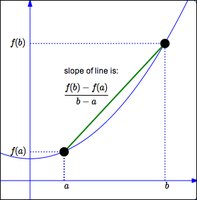
This image illustrates the concept of average rate of change. The slope of the green secant line between points (a, f(a)) and (b, f(b)) is calculated using the formula , representing the average rate of change of the function between these two points.
