 Back
BackPiecewise-Defined Functions: Identifying the Rule from a Graph
Study Guide - Smart Notes
 Tailored notes based on your materials, expanded with key definitions, examples, and context.
Q1. Give a rule for the piecewise-defined function represented by the graph.
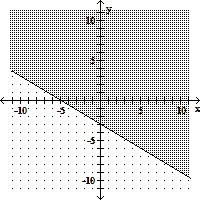
Background
Topic: Piecewise-Defined Functions
This question tests your ability to interpret a graph and write the corresponding piecewise-defined function. Piecewise functions are defined by different expressions depending on the interval of the input variable (x).
Key Terms and Concepts:
Piecewise Function: A function defined by multiple sub-functions, each applying to a certain interval of the domain.
Open Circle: Indicates that the endpoint is not included (strict inequality, e.g., x < a or x > a).
Closed Circle: Indicates that the endpoint is included (inclusive inequality, e.g., x ≤ a or x ≥ a).
Step-by-Step Guidance
Examine the graph and identify the different segments or pieces. Notice where the graph changes direction or has open/closed circles.
For each segment, determine the equation of the line or curve. Use two points on each segment to find the slope and y-intercept if the segment is linear.
Identify the domain for each piece by looking at the x-values where each segment is defined. Pay attention to open and closed circles to determine whether endpoints are included or excluded.
Write the piecewise function using the equations and their corresponding domains. Use proper notation for open and closed intervals.
Try solving on your own before revealing the answer!
Final Answer:
f(x) = { 2x + 3, for x < -1; 2, for -1 ≤ x ≤ 1; 2x + 1, for x > 1 }
The graph consists of three pieces: a line for x < -1, a constant for -1 ≤ x ≤ 1, and another line for x > 1, with open and closed circles indicating the inclusion or exclusion of endpoints.
