 Back
Polynomial and Rational Inequalities: Methods and Applications
Study Guide - Smart Notes
 Tailored notes based on your materials, expanded with key definitions, examples, and context.
Polynomial and Rational Inequalities
Introduction
Polynomial and rational inequalities are fundamental concepts in College Algebra. They involve finding the set of real numbers for which a polynomial or rational function satisfies a given inequality. Mastery of these topics is essential for solving real-world problems and understanding advanced algebraic concepts.
Solving Polynomial Inequalities
Definition of a Polynomial Inequality
A polynomial inequality is an inequality involving a polynomial function, such as , , , or . The goal is to determine the values of for which the inequality holds.
Procedure for Solving Polynomial Inequalities
To solve a polynomial inequality, follow these steps:
Express the inequality in the form or , where is a polynomial function.
Solve the equation . The real solutions are called boundary points.
Locate these boundary points on a number line, dividing the number line into intervals.
Choose a test value within each interval and evaluate at that number.
Write the solution set, selecting the intervals that satisfy the given inequality. If the inequality is or , include the boundary points in the solution set.
Example: Solving a Polynomial Inequality
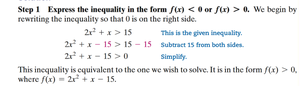
Consider the inequality .
Step 1: Express the inequality in the form . Subtract 15 from both sides: Let .
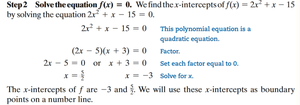
Step 2: Solve . Factor: Solutions: ,
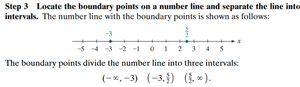
Step 3: Locate boundary points on a number line and separate into intervals. Intervals: , ,
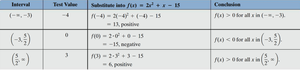
Step 4: Choose a test value in each interval and evaluate . See table below:
Interval
Test Value
Substitute into
Conclusion
-4
(positive)
for all in
0
(negative)
for all in
3
(positive)
for all in
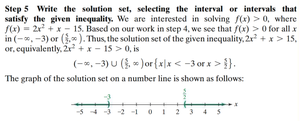
Step 5: Write the solution set. The solution set is . Graphically:
Solving Rational Inequalities
Definition of a Rational Inequality
A rational inequality is an inequality involving a rational function, which is a quotient of two polynomials. The solution involves finding values of for which the rational function satisfies the inequality.
Procedure for Solving Rational Inequalities
To solve a rational inequality, follow these steps:
Express the inequality so that one side is zero and the other is a single quotient.
Set the numerator and denominator equal to zero to find boundary points.
Locate boundary points on a number line and divide into intervals.
Choose a test value in each interval and evaluate the rational function.
Write the solution set, selecting intervals that satisfy the inequality. Exclude points where the denominator is zero (undefined).
Example: Solving a Rational Inequality
Consider the inequality .
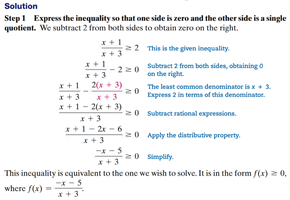
Step 1: Express the inequality so one side is zero. Subtract 2: Combine into a single quotient: Simplify:
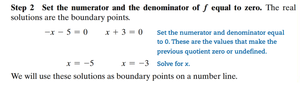
Step 2: Set numerator and denominator equal to zero. Numerator: Denominator:
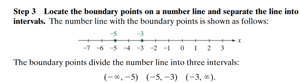
Step 3: Locate boundary points on a number line and separate into intervals. Intervals: , ,
Step 4: Choose a test value in each interval and evaluate . See table below:
Interval
Test Value
Substitute into
Conclusion
-6
(negative)
for all in
-4
(positive)
for all in
0
(negative)
for all in
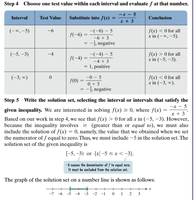
Step 5: Write the solution set. The solution set is , including if the inequality is but excluding (undefined). Graphically:
Applications: Position Function for a Free-Falling Object
Application Example
Polynomial and rational inequalities can be used to model real-world scenarios, such as the position of a free-falling object near Earth's surface. The position function is typically given by , where is the height at time , is the initial velocity, and is the initial height.
Example: Find the time interval during which an object is more than 64 feet above the ground. Set up the inequality: Solve for using the methods described above. After testing intervals, the solution may be , meaning the object is above 64 feet between 1 and 4 seconds (excluding endpoints).
Summary Table: Steps for Solving Inequalities
Step | Polynomial Inequality | Rational Inequality |
|---|---|---|
1 | Express in or form | Express as a single quotient |
2 | Solve for boundary points | Set numerator and denominator to zero for boundary points |
3 | Divide number line into intervals | Divide number line into intervals |
4 | Test values in each interval | Test values in each interval |
5 | Select intervals satisfying the inequality | Select intervals satisfying the inequality (exclude points where denominator is zero) |
