 Back
BackPolynomial Functions: End Behavior, Zeros, Multiplicity, and Graphing
Study Guide - Smart Notes
 Tailored notes based on your materials, expanded with key definitions, examples, and context.
Polynomial Functions
End Behavior of Polynomial Functions
Understanding the end behavior of a polynomial function helps predict how the function behaves as x approaches positive or negative infinity. The end behavior is determined by the leading term of the polynomial, which is the term with the highest degree.
Notation:
x → ∞: x becomes infinitely large in the positive direction.
x → -∞: x becomes infinitely large in the negative direction.
f(x) → ∞: The y-value becomes infinitely large in the positive direction.
f(x) → -∞: The y-value becomes infinitely large in the negative direction.
Leading Term Test: For a polynomial $f(x) = a_n x^n + \ldots + a_0$, the leading term $a_n x^n$ determines the end behavior.
Even Degree: Both ends of the graph go in the same direction (up if $a_n > 0$, down if $a_n < 0$).
Odd Degree: The ends of the graph go in opposite directions (up to the right if $a_n > 0$, up to the left if $a_n < 0$).

Example: For $f(x) = 5x^5 - 4x^3 + x$, the leading term is $5x^5$ (odd degree, positive coefficient), so as $x \to \infty$, $f(x) \to \infty$ and as $x \to -\infty$, $f(x) \to -\infty$.
Zeros and Multiplicities of Zeros
The zeros of a polynomial function are the values of x for which $f(x) = 0$. These correspond to the x-intercepts of the graph. The multiplicity of a zero refers to how many times a particular zero is repeated as a factor.
Zero of Multiplicity k: If $(x-c)^k$ is a factor, then $x = c$ is a zero of multiplicity $k$.
Odd Multiplicity: The graph crosses the x-axis at $x = c$.
Even Multiplicity: The graph touches but does not cross the x-axis at $x = c$.
Example: For $f(x) = (x-1)^2(x+3)^3$, $x=1$ is a zero of multiplicity 2 (touches), $x=-3$ is a zero of multiplicity 3 (crosses).
Effect of Multiplicities on the Graph
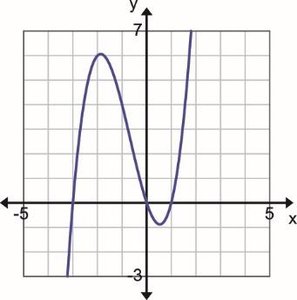
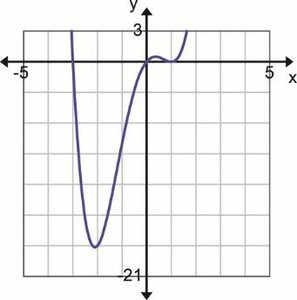
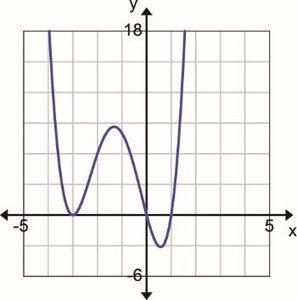
The behavior of the graph at each zero depends on the multiplicity:
Odd multiplicity: The graph crosses the x-axis.
Even multiplicity: The graph touches the x-axis and turns around.
Turning Points of Polynomial Functions
A turning point is where the graph changes direction from increasing to decreasing or vice versa. The maximum number of turning points for a polynomial of degree n is n − 1.
Relative Maximum: The highest point in a particular section of the graph.
Relative Minimum: The lowest point in a particular section of the graph.
Example: A cubic polynomial ($n=3$) can have at most 2 turning points.
Steps to Sketch a Polynomial Function
To graph a polynomial function $y = f(x)$, follow these steps:
Use the leading term to determine end behavior.
Find the y-intercept by evaluating $f(0)$.
Find the real zeros and their multiplicities (x-intercepts).
Plot the x- and y-intercepts and sketch the end behavior.
Connect the intercepts, crossing or touching the x-axis as dictated by multiplicity.
Test for symmetry:
Even function: $f(-x) = f(x)$ (symmetric to y-axis).
Odd function: $f(-x) = -f(x)$ (symmetric to origin).
Plot additional points for accuracy, especially near turning points.
Intermediate Value Theorem
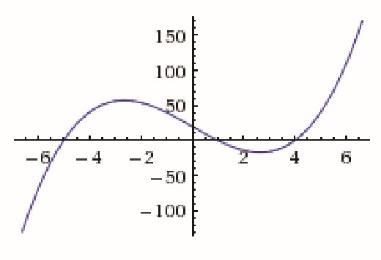
The Intermediate Value Theorem states that if $f$ is a polynomial function and $f(a)$ and $f(b)$ have opposite signs for $a < b$, then $f$ has at least one zero in the interval $[a, b]$.
Application: Use this theorem to show the existence of a zero in a given interval by checking the signs of $f(a)$ and $f(b)$.
Example: For $f(x) = x^3 - 2x^2 + 13x + 35$, if $f(-1)$ and $f(0)$ have opposite signs, then there is at least one zero in $[-1, 0]$.
