 Back
BackQuadratic and Polynomial Functions: Definitions, Properties, and Theorems
Study Guide - Smart Notes
 Tailored notes based on your materials, expanded with key definitions, examples, and context.
Quadratic Functions and Their Graphs
Definition and Forms
A quadratic function is a function of the form:
General form: ,
Vertex form: ,
The graph of a quadratic function is called a parabola. Every parabola has a vertical line called the axis of symmetry, which passes through the vertex (the highest or lowest point of the parabola).
Properties of Quadratic Functions
Vertex (vertex form): For , the vertex is and the axis of symmetry is .
Vertex (general form): For , the vertex is and the axis of symmetry is .
Direction: If , the parabola opens upward (vertex is a minimum). If , the parabola opens downward (vertex is a maximum).
Examples
Example 1:
Opens upward ()
Vertex: , ; vertex is
Axis of symmetry:
Intercepts: -intercept at , ; -intercepts by solving
Vertex is a minimum
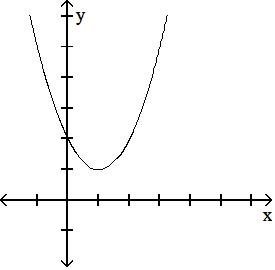
Example 2:
Opens downward ()
Vertex: , ; vertex is
Axis of symmetry:
Vertex is a maximum
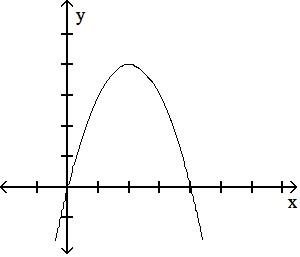
Example 3:
Opens upward ()
Vertex:
Axis of symmetry:
Vertex is a minimum
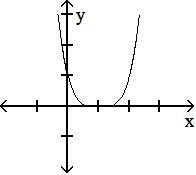
Converting to Vertex Form
Complete the square to rewrite as .
Applications
Projectile motion: The height of a thrown object can be modeled by a quadratic function, e.g., .
Optimization: Maximizing area or other quantities often leads to quadratic functions.
Polynomial Functions and Their Graphs
Definition
A polynomial function of degree is defined as:
, where
Leading coefficient:
End Behaviors of Polynomial Functions
Leading Coefficient Test: The end behavior of the graph depends on the sign of the leading coefficient and the degree .
If is even and , both ends rise; if , both ends fall.
If is odd and , left end falls and right end rises; if , left end rises and right end falls.
Zeros and Multiplicities
Zero: is a zero of if .
Multiplicity: If is a factor, is a zero of multiplicity .
If is odd, the graph crosses the -axis at ; if is even, the graph touches and turns around at .
Turning Points
A polynomial of degree has at most turning points.
Intermediate Value Theorem (IVT)
If and have opposite signs, there is at least one zero between and .
Dividing Polynomials, Remainder and Factor Theorems
Long Division
For polynomials and , , where has degree less than .
Synthetic Division
Efficient method for dividing by .
Remainder Theorem
If is divided by , the remainder is .
Factor Theorem
is a factor of if and only if .
Zeros of Polynomials
Rational Zero Theorem
If is a rational zero, divides the constant term and divides the leading coefficient.
Fundamental Theorem of Algebra
A degree polynomial has exactly complex zeros (counting multiplicities).
Descartes’s Rule of Signs
The number of positive real zeros equals the number of sign changes in (or less by an even number).
The number of negative real zeros equals the number of sign changes in (or less by an even number).
