 Back
BackQuadratic Equations: Methods of Solution and Properties
Study Guide - Smart Notes
 Tailored notes based on your materials, expanded with key definitions, examples, and context.
Quadratic Equations
Definition and Standard Form
A quadratic equation is an algebraic equation of the second degree, meaning the highest exponent of the variable is 2. The standard form of a quadratic equation is:
Standard Form:
Where a, b, and c are real numbers, and a \neq 0.
Examples:
(a = 1, b = -4, c = 5)
(a = -3, b = 7, c = -8)
Types of Quadratic Expressions
Monomial:
Binomial:
Trinomial:
Factoring Quadratic Equations
Factoring a Difference of Squares
The difference of squares formula is:
Always factor out the greatest common factor (GCF) first.
Example: Factor
Zero-Product Principle
If the product of two expressions is zero, then at least one of the factors must be zero:
If , then or
Example: If , then or , so or .
Methods to Solve Quadratic Equations
Overview of Solution Methods
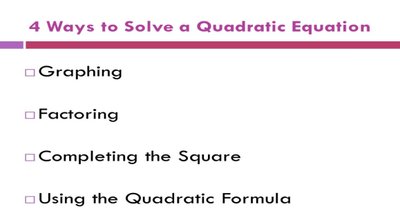
There are four main methods to solve quadratic equations:
Factoring
Square Root Property
Completing the Square
Using the Quadratic Formula
Factoring (ac Method)
To factor a quadratic equation :
Factor out the GCF.
Find two numbers whose product is and whose sum is .
Rewrite the middle term using these numbers.
Group and factor each part.
Apply the zero-product principle to solve for .
Example: Solve by factoring.
Find numbers: ,
Rewrite:
Group:
Factor:
Combine:
Solutions: ,
Square Root Property
For equations of the form :
Steps:
Isolate the squared term.
Take the square root (include ).
Isolate the variable.
Check solutions.
Example: Solve
Completing the Square
Some quadratic equations cannot be factored easily. Completing the square rewrites the equation as a perfect square trinomial.
Move the constant to the right side.
Divide both sides by the coefficient of .
Add to both sides.
Factor the left side as a square.
Take the square root of both sides.
Solve for .
Example: Solve by completing the square.
Move constant:
Divide by 2:
Add to both sides:
Factor:
Take square root:
Solutions: ,
Quadratic Formula
The quadratic formula can solve any quadratic equation:
Example: Solve
, ,
Solutions: ,
Discriminant and Types of Solutions
Discriminant
The discriminant of a quadratic equation is .
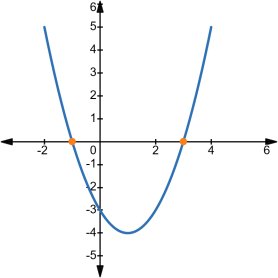
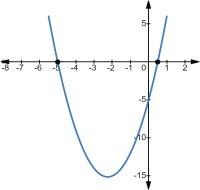
If : Two distinct real solutions (graph crosses x-axis twice).
If : One real solution (graph touches x-axis once).
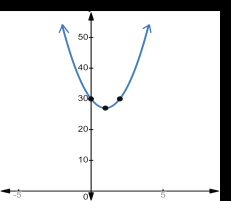
If : Two distinct imaginary solutions (graph does not touch x-axis).
Summary of Methods
Method | Can be Used | Comments |
|---|---|---|
Factoring | Sometimes | Use if constant term is zero or factors are easily determined |
Square Root Property | Sometimes | Use for equations where b = 0 |
Quadratic Formula or Completing the Square | Always | Always gives accurate solutions; other methods may be easier in some cases |
