 Back
BackQuadratic Functions: Concepts, Graphing, and Applications
Study Guide - Smart Notes
 Tailored notes based on your materials, expanded with key definitions, examples, and context.
Section 4.1: Quadratic Functions
Solving Quadratic Equations
Quadratic equations are equations of the form ax2 + bx + c = 0. There are several methods to solve quadratic equations, including factoring, completing the square, and using the quadratic formula.
Factoring and the Zero Product Property: If a quadratic can be factored, set each factor equal to zero and solve for x. Example: Solve Factoring: Solutions:
Completing the Square: Rewrite the equation in the form and solve for x. Example: Move constant: Add to both sides: So, Solutions:
Quadratic Formula: For any quadratic , the solutions are:
Graphing Quadratic Functions
A quadratic function is any function that can be written as , where . The graph of a quadratic function is a parabola.
Standard Form:
Vertex Form:
Axis of Symmetry: The vertical line (in vertex form) or (in standard form).
Vertex: The point in vertex form, or in standard form.
Direction: If , the parabola opens upward; if , it opens downward.
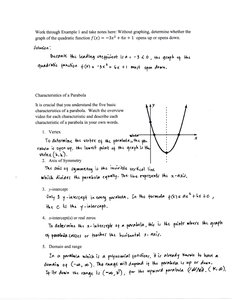
Characteristics of a Parabola
Vertex: The highest or lowest point of the parabola.
Axis of Symmetry: The vertical line passing through the vertex.
Y-intercept: The point where the graph crosses the y-axis ().
X-intercepts (Roots): The points where the graph crosses the x-axis (solutions to ).
Domain: All real numbers, .
Range: If , ; if , .
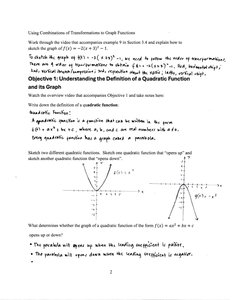
Objective 1: Understanding the Definition of a Quadratic Function and Its Graph
A quadratic function is a function that can be written in the form , where . The graph is a parabola that opens upward if and downward if .
Leading Coefficient: Determines the direction the parabola opens.
Sketching: Draw the axis of symmetry, vertex, and a few points on either side.
Objective 2: Graphing Quadratic Functions Written in Vertex Form
The vertex form of a quadratic function is . This form makes it easy to identify the vertex and the direction the parabola opens.
Vertex:
Axis of Symmetry:
Y-intercept: Set and solve for
Graphing Steps:
Plot the vertex
Draw the axis of symmetry
Find and plot the y-intercept and additional points
Sketch the parabola
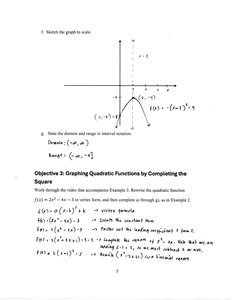
Objective 3: Graphing Quadratic Functions by Completing the Square
Completing the square is a method to rewrite a quadratic function in vertex form, which helps in graphing and identifying the vertex.
Given , factor out from the and terms, then complete the square inside the parentheses.
Rewrite as to identify the vertex and graph.
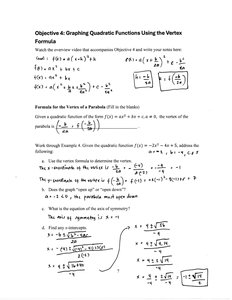
Objective 4: Graphing Quadratic Functions Using the Vertex Formula
The vertex of a parabola given by can be found using the vertex formula:
Vertex Formula:
Substitute into to find the -coordinate of the vertex.
Use the vertex, axis of symmetry, and intercepts to sketch the graph.
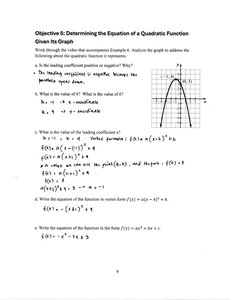
Objective 5: Determining the Equation of a Quadratic Function Given Its Graph
Given a graph of a parabola, you can determine the equation by identifying the vertex, axis of symmetry, and another point on the graph.
Determine if the parabola opens up or down (sign of ).
Identify the vertex and write the equation in vertex form: .
Use another point to solve for .
Rewrite in standard form if needed: .
Summary Table: Key Features of Quadratic Functions
Form | Vertex | Axis of Symmetry | Direction | Y-intercept |
|---|---|---|---|---|
Standard: | : Up : Down | |||
Vertex: | : Up : Down | Set |
Additional info: These notes cover the core concepts of quadratic functions, including solving, graphing, and analyzing their properties, as required in a college algebra course.
