 Back
BackQuadratic Functions: Concepts, Graphs, and Applications
Study Guide - Smart Notes
 Tailored notes based on your materials, expanded with key definitions, examples, and context.
Quadratic Functions
Introduction to Quadratic Functions
Quadratic functions are a fundamental class of polynomial functions that appear frequently in algebra and real-world applications. A quadratic function is any function that can be written in the form , where and , , and are real numbers.
Standard Form:
Vertex Form:
Axis of Symmetry: The vertical line (in vertex form) or (in standard form)
Graph: The graph of a quadratic function is a parabola that opens upward if and downward if .
Graphs of Quadratic Functions
The graph of a quadratic function is a parabola. The vertex is the highest or lowest point, depending on the direction the parabola opens. The axis of symmetry passes through the vertex and divides the parabola into two mirror images.
Vertex: The point in vertex form or in standard form.
Direction: Determined by the sign of .
Y-intercept: The point .
X-intercepts (Roots): The solutions to .
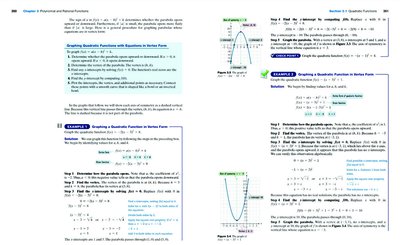
Graphing Quadratic Functions in Standard Form
To graph a quadratic function in standard form, follow these steps:
Find the vertex using and .
Determine the axis of symmetry ().
Find the y-intercept ().
Find the x-intercepts by solving (if real solutions exist).
Plot additional points as needed for accuracy.
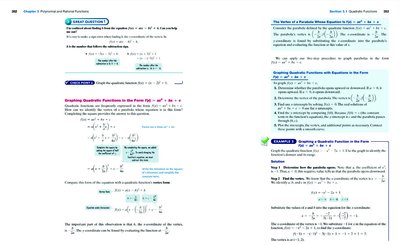
Graphing Quadratic Functions in Vertex Form
Vertex form makes it easy to identify the vertex and direction of the parabola. The function has vertex and opens upward if , downward if .
Plot the vertex .
Draw the axis of symmetry .
Choose points on either side of the vertex to plot the parabola.
Converting Between Forms
Quadratic functions can be converted between standard and vertex forms by completing the square:
Given , rewrite as by completing the square.
Vertex: , .
Properties of Quadratic Functions
Maximum/Minimum Value: The vertex gives the maximum (if ) or minimum (if ) value of the function.
Domain: All real numbers, .
Range: if ; if .
Applications of Quadratic Functions
Quadratic functions model many real-world phenomena, such as projectile motion, area optimization, and revenue maximization. The vertex often represents the optimal value (maximum height, minimum cost, etc.).
Projectile Motion: The height of an object thrown upward can be modeled by (in feet, with in seconds).
Optimization: Quadratic functions are used to find maximum or minimum values in various contexts.
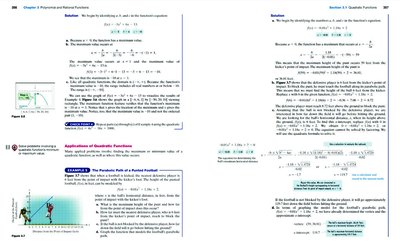
Summary Table: Key Features of Quadratic Functions
Feature | Standard Form | Vertex Form |
|---|---|---|
Equation | ||
Vertex | ||
Axis of Symmetry | ||
Y-intercept | ||
Direction | Up if , Down if | Up if , Down if |
Example: Finding the Vertex and Graphing
Given :
Find the vertex: ,
Vertex:
Axis of symmetry:
Y-intercept:
Graph the parabola opening upward.
Example: Application to Projectile Motion
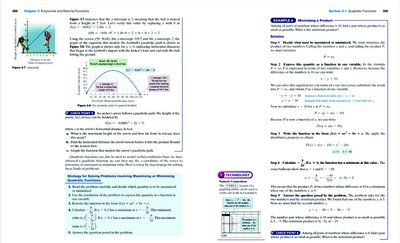
A ball is thrown upward with an initial velocity of 32 ft/s from a height of 5 ft. Its height after seconds is .
Maximum height occurs at second.
Maximum height: ft.
Additional info: The notes also include step-by-step examples for graphing, converting forms, and solving application problems, as well as summary tables for quick reference.
