 Back
R.1 Real Numbers and Fundamental Properties
Study Guide - Smart Notes
 Tailored notes based on your materials, expanded with key definitions, examples, and context.
R.1 Real Numbers
Working with Sets
In mathematics, a set is a collection of distinct objects or elements defined by a rule. Sets are fundamental to understanding number classifications and algebraic structures.
Example: The set of digits is D = {0, 1, 2, 3, 4, 5, 6, 7, 8, 9}.
Sets with a finite number of elements can be listed explicitly.
For sets with infinite or complex membership, set-builder notation is used: A = {x | x ∈ ℝ, x ≥ 3} means "A is the set of real numbers x such that x is greater than or equal to 3."
Classifying Numbers
Numbers are classified into various types based on their properties. Understanding these classifications is essential for algebraic reasoning.
Natural Numbers (Counting Numbers): ℕ = {1, 2, 3, 4, ...}
Whole Numbers: ℕ₀ = {0, 1, 2, 3, ...}
Integers: ℤ = {..., -3, -2, -1, 0, 1, 2, 3, ...}
Rational Numbers: Numbers that can be expressed as a quotient , where a and b are integers and b ≠ 0. ℚ = {x | x = , a, b ∈ ℤ, b ≠ 0}
Irrational Numbers: Numbers that cannot be written as , where a and b are integers and b ≠ 0. Their decimal forms are nonterminating and nonrepeating (e.g., , , ).
Real Numbers: The set of all rational and irrational numbers.
Example: -8 is an integer and a real number, but not a natural or whole number.
Ellipsis (...): Indicates that a pattern continues indefinitely.
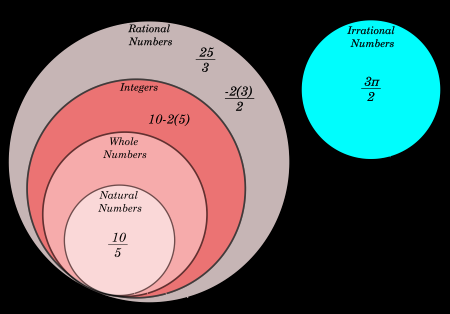
Rational vs. Irrational Numbers
Rational Numbers: , ,
Irrational Numbers: , ,
The Order of Operations
PEMDAS Rule
When evaluating mathematical expressions, operations must be performed in a specific order, summarized by the acronym PEMDAS:
P: Parentheses or grouping symbols. Perform operations within the innermost parentheses first.
E: Exponents. Evaluate powers and roots.
MD: Multiplication or Division. Perform these operations from left to right.
AS: Addition or Subtraction. Perform these operations from left to right.
Example: Evaluate the expression by following PEMDAS.
Properties of Real Numbers
Reciprocal
The reciprocal of a nonzero real number b is . For example, the reciprocal of 7 is , and the reciprocal of is .
Distributive Property
The distributive property of multiplication over addition states:
Example:
Rules of Signs
Negative signs in fractions can be written in several equivalent ways:
Example:
When there are two terms in the numerator or denominator, apply the negative sign carefully:
Multiplying and Adding Fractions
Multiplying Fractions
To multiply fractions, multiply the numerators and denominators directly. Simplify before multiplying if possible.
Example:
Adding Fractions
To add fractions with the same denominator, add the numerators:
If denominators differ, find the least common multiple (LCM) of the denominators before adding:
Example:
List multiples of 15 and 12 to find the LCM (e.g., 60 is the LCM of 15 and 12).
Type of Number | Definition | Example |
|---|---|---|
Natural Numbers | Counting numbers | 1, 2, 3, ... |
Whole Numbers | Natural numbers plus zero | 0, 1, 2, ... |
Integers | Whole numbers and their negatives | -3, 0, 2, ... |
Rational Numbers | Numbers expressible as | , |
Irrational Numbers | Non-repeating, non-terminating decimals | , |
