 Back
BackRational Functions and Their Graphs: Asymptotes and Applications
Study Guide - Smart Notes
 Tailored notes based on your materials, expanded with key definitions, examples, and context.
Rational Functions and Models
Definition of Rational Functions
A rational function is any function that can be written in the form , where and are polynomials and . The domain of a rational function is all real numbers except those for which (since division by zero is undefined).
Key Point: The domain excludes all -values that make the denominator zero.
Example: has domain .
Determining Rational Functions and Their Domains
To determine if a function is rational, check if it is a ratio of polynomials. For each rational function, set the denominator equal to zero and solve for to find excluded values from the domain.
Example: is rational. The domain is all real except and .
Asymptotes of Rational Functions
Vertical Asymptotes
A vertical asymptote occurs at if and . As approaches from the left or right, increases or decreases without bound (i.e., or ).
Key Point: Vertical asymptotes correspond to zeros of the denominator that are not canceled by the numerator.
Example: has a vertical asymptote at .
Horizontal Asymptotes
A horizontal asymptote is a horizontal line that the graph of approaches as or . The existence and location of horizontal asymptotes depend on the degrees of the numerator and denominator polynomials:
If degree of numerator < degree of denominator: is the horizontal asymptote.
If degrees are equal: , where and are the leading coefficients of the numerator and denominator, respectively.
If degree of numerator > degree of denominator: There is no horizontal asymptote.
Finding Asymptotes: Step-by-Step
Factor numerator and denominator to lowest terms. Cancel any common factors.
Vertical Asymptotes: Set the denominator equal to zero and solve for .
Horizontal Asymptotes: Compare the degrees of numerator and denominator and apply the rules above.
Graphical Examples of Asymptotes
The following graphs illustrate rational functions with vertical and horizontal asymptotes:
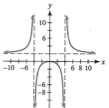
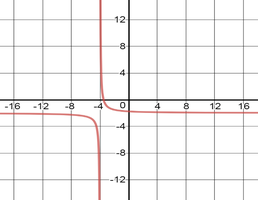
Applications of Rational Functions
Population and Survival Models
Rational functions are often used to model real-world phenomena such as population growth or survival rates. For example, the population of rabbits on a farm or the percentage of trees surviving to a certain age can be modeled using rational functions.
Example: models the population of rabbits months after introduction.
To find and : Substitute and into the formula.
Horizontal Asymptote: As , approaches the ratio of the leading coefficients, indicating the long-term population limit.
Vertical Asymptote: If the denominator can be zero for some , interpret whether this makes sense in the context (e.g., negative time may not be meaningful).
Interpreting Asymptotes in Context
Horizontal asymptote: Represents the long-term behavior or limiting value of the model (e.g., maximum sustainable population).
Vertical asymptote: May indicate a value of the independent variable where the model breaks down or is not applicable.
Summary Table: Asymptote Rules for Rational Functions
Case | Horizontal Asymptote | Vertical Asymptote |
|---|---|---|
deg(numerator) < deg(denominator) | Set denominator = 0 | |
deg(numerator) = deg(denominator) | (leading coefficients) | Set denominator = 0 |
deg(numerator) > deg(denominator) | None | Set denominator = 0 |
Additional info: In some cases, rational functions may have oblique (slant) asymptotes if the degree of the numerator is exactly one more than the degree of the denominator. These are not covered in detail here but are part of further algebra topics.
