 Back
Solving Linear Equations and Applied Problems in College Algebra
Study Guide - Smart Notes
 Tailored notes based on your materials, expanded with key definitions, examples, and context.
Equations and Inequalities
Introductory Terms and Definitions
Understanding the foundational terminology of equations is essential for success in College Algebra. These terms are used throughout the course and form the basis for solving equations.
Equation in one variable: A statement where two expressions are set equal to each other, with at least one containing the variable to solve for.
Sides of the equation: Each expression in the equation is referred to as a side.
Solutions (roots): Values of the variable that satisfy the equation.
Domain: The set of all possible values a variable may assume. Do not confuse this with the solution set.
Solution set: The set of all solutions to the equation.
Equivalent equation: An equation with the same solution set as another equation.
Linear Equations
A linear equation is a fundamental type of equation in algebra. It is characterized by the variable appearing only to the first power.
Definition: A linear equation is one that can be written in the form , where , , and are constants and is the variable.
First-degree equation: The variable has an exponent of 1.
Producing Equivalent Equations
Solving linear equations often involves rewriting the original equation as an equivalent equation in the form variable = number. Common techniques include:
Addition/Subtraction: Adding or subtracting the same value from both sides.
Multiplication/Division: Multiplying or dividing both sides by the same nonzero value. Never divide by an expression containing the variable.
Formal Process for Solving Linear Equations
Solving a linear equation involves a systematic approach to isolate the variable.
Step 1: Expand and simplify both sides of the equation.
Step 2: Clear any fractions, if present.
Step 3: Use addition/subtraction to move terms.
Step 4: Use multiplication/division to isolate the variable.
Step 5: Check the solution by substituting back into the original equation.
Informal Approach to Solving Linear Equations
Sometimes, a less formal approach can help students understand the process. The key is to perform the "opposite" operation to both sides to isolate the variable.
Example: Solve .
Subtract 9 from both sides:
Simplifies to:
Divide both sides by 4:
Note: The "opposite" operation is used to move terms away from the variable.
Solving Applied Problems
Steps for Solving Applied Problems
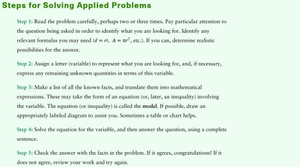
Applied problems (word problems) require translating real-world situations into mathematical equations. The following steps provide a structured approach:
Step 1: Read the problem carefully, identifying what is being asked and any relevant formulas.
Step 2: Assign a variable to represent the unknown quantity.
Step 3: List known facts and translate them into mathematical expressions.
Step 4: Solve the equation for the variable and answer the question.
Step 5: Check the answer with the facts in the problem.
Example: If a problem asks for the number of items sold given total revenue and price per item, assign as the number of items, set up the equation, and solve for $x$.
Additional info: These steps are applicable to a wide range of algebraic word problems, including those involving linear equations, proportions, and other basic algebraic relationships.
