 Back
Solving Rational Equations Algebraically
Study Guide - Smart Notes
 Tailored notes based on your materials, expanded with key definitions, examples, and context.
Solving Rational Equations Algebraically
Introduction
Rational equations are equations that involve rational expressions, which are fractions containing polynomials in the numerator and denominator. Solving these equations is a fundamental skill in College Algebra, particularly in the study of polynomial and rational functions. The process typically involves finding a common denominator, clearing fractions, and solving the resulting polynomial equation.
Key Concepts in Solving Rational Equations
Rational Expression: An expression of the form \( \frac{P(x)}{Q(x)} \), where \(P(x)\) and \(Q(x)\) are polynomials and \(Q(x) \neq 0\).
Least Common Multiple (LCM): The smallest expression that is a multiple of all denominators in the equation. Used to clear fractions.
Extraneous Solutions: Solutions that arise from the algebraic process but do not satisfy the original equation, often due to division by zero.
Solving Rational Equations: Step-by-Step
Step 1: Identify the LCM of Denominators
To eliminate fractions, multiply both sides of the equation by the LCM of all denominators. This step is crucial for simplifying the equation.
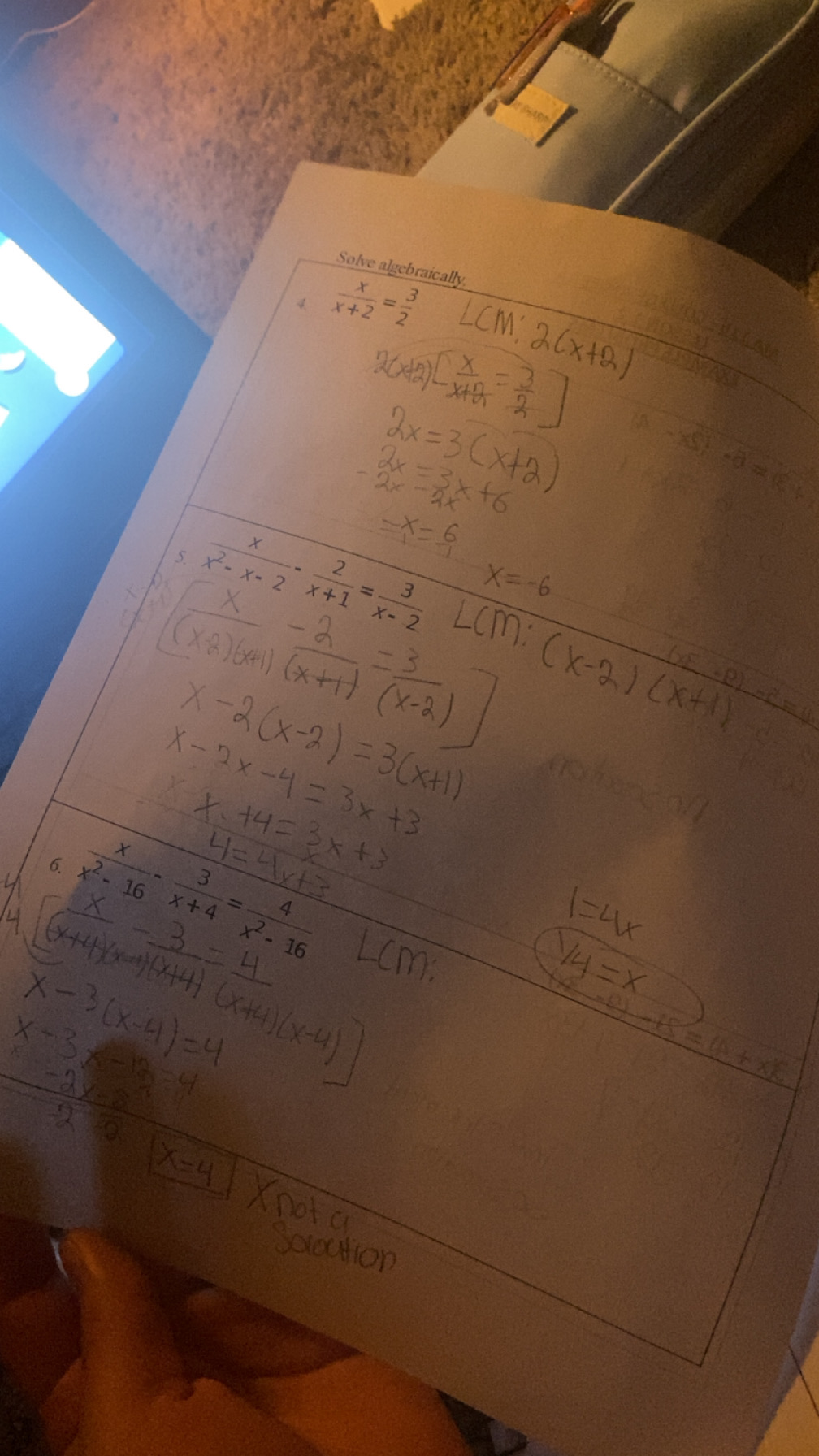
Example: For \( \frac{x}{x+2} = \frac{3}{2} \), the LCM is \(2(x+2)\).
Step 2: Multiply Both Sides by the LCM
Apply the LCM to each term to clear the denominators, resulting in a polynomial equation.
Example: \(2(x+2)\left[\frac{x}{x+2}\right] = 2(x+2)\left[\frac{3}{2}\right]\)
This simplifies to \(2x = 3(x+2)\).
Step 3: Solve the Resulting Equation
Expand and solve the polynomial equation for the variable.
Example: \(2x = 3x + 6\) leads to \(-x = 6\), so \(x = -6\).
Step 4: Check for Extraneous Solutions
Substitute the solution back into the original equation to ensure it does not make any denominator zero.
Example: If \(x = 4\) makes a denominator zero, it is not a valid solution.
Examples of Solving Rational Equations
Example 1: Simple Rational Equation
\( \frac{x}{x+2} = \frac{3}{2} \)
LCM: \(2(x+2)\)
Multiply both sides: \(2x = 3(x+2)\)
Solve: \(2x = 3x + 6 \Rightarrow -x = 6 \Rightarrow x = -6\)
Check: \(x = -6\) does not make denominator zero.
Example 2: Rational Equation with Multiple Denominators
\( \frac{x}{x-2} - \frac{2}{x+1} = \frac{3}{x-2} \)
LCM: \((x-2)(x+1)\)
Multiply both sides: \(x(x+1) - 2(x-2) = 3(x+1)\)
Expand: \(x^2 + x - 2x + 4 = 3x + 3\)
Solve: \(x^2 - x + 4 = 3x + 3\)
Rearrange: \(x^2 - 4x + 1 = 0\)
Check for extraneous solutions.
Example 3: Rational Equation with Quadratic Denominators
\( \frac{x}{x+4} - \frac{3}{x-4} = \frac{4}{x^2 - 16} \)
LCM: \((x+4)(x-4)\)
Multiply both sides: \(x(x-4) - 3(x+4) = 4\)
Expand: \(x^2 - 4x - 3x - 12 = 4\)
Solve: \(x^2 - 7x - 16 = 4\)
Rearrange: \(x^2 - 7x - 20 = 0\)
Factor: \((x-4)(x-5) = 0\)
Solutions: \(x = 4\) or \(x = 5\)
Check: \(x = 4\) makes denominator zero, so it is not a solution.
Summary Table: Steps for Solving Rational Equations
Step | Description |
|---|---|
1 | Find the LCM of all denominators |
2 | Multiply both sides by the LCM to clear fractions |
3 | Solve the resulting polynomial equation |
4 | Check for extraneous solutions |
Additional info:
These notes are directly relevant to College Algebra, specifically to Chapter 5: Polynomial and Rational Functions, and Chapter 8: Systems of Equations and Inequalities. The examples provided illustrate the process of solving rational equations, a key skill for understanding more advanced algebraic concepts.
