 Back
BackSolving Word Problems and Applications in College Algebra
Study Guide - Smart Notes
 Tailored notes based on your materials, expanded with key definitions, examples, and context.
Models and Applications: Solving Word Problems
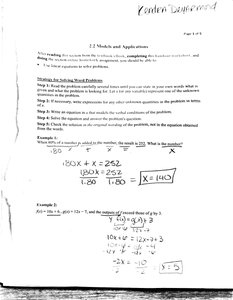
Strategies for Solving Word Problems
Word problems are a fundamental part of college algebra, requiring students to translate real-world situations into mathematical equations and solve for unknowns. The following steps provide a structured approach to solving word problems:
Step 1: Read the problem carefully. Identify what is being asked and what information is provided.
Step 2: Assign variables. Let variables represent the unknown quantities in the problem.
Step 3: Write an equation. Use the information given to form an equation relating the variables.
Step 4: Solve the equation. Use algebraic methods to solve for the unknown variable(s).
Step 5: Answer the question. Interpret the solution in the context of the original problem.
Step 6: Check your answer. Verify that your solution makes sense and satisfies the conditions of the problem.
Example: Solving a Linear Equation from a Word Problem
Consider a problem where you must solve for x in the equation .
Step 1: Combine like terms:
Step 2: Set up the equation:
Step 3: Solve for x:
Step 4: Interpret the answer in context.
Example: Solving for an Unknown with Multiple Steps
Given the equation , solve for x:
Step 1: Combine like terms:
Step 2: Set up the equation:
Step 3: Solve for x:
Applications: Using Data and Graphs in Word Problems
Interpreting Bar Graphs and Setting Up Equations
Many word problems use data from graphs to set up equations. For example, a bar graph may show the average number of years spent in various activities. You may be asked to write an equation based on this data and solve for an unknown.
Step 1: Identify the relevant data from the graph.
Step 2: Assign variables to unknowns.
Step 3: Write an equation using the data.
Step 4: Solve for the unknown.
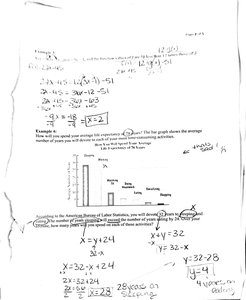
Example: Solving for Years Based on Data
Suppose the equation is , where x is the total years and y is the years spent in a specific activity. If , solve for y:
Applications: Linear Equations in Financial and Practical Contexts
Solving for Unknowns in Financial Word Problems
Financial word problems often require setting up and solving linear equations. For example, determining how many years it will take for a car's value to depreciate to a certain amount.
Step 1: Assign variables to unknowns (e.g., x for years).
Step 2: Write an equation based on the depreciation rate.
Step 3: Solve for x.
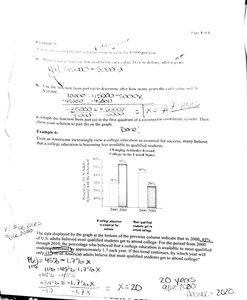
Example: Depreciation Problem
If a car depreciates at a rate of per year and its value after x years is $252$, set up and solve the equation:
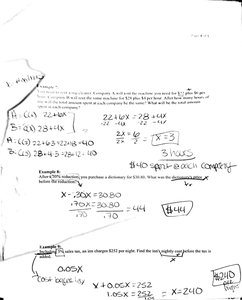
Advanced Applications: Multiple Variables and Geometry
Solving Equations with Multiple Variables
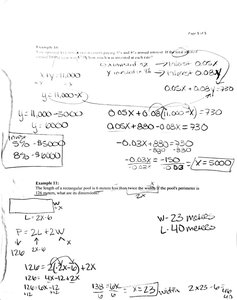
Some word problems involve more than one variable, such as perimeter problems in geometry. For example, finding the width and length of a rectangle given its perimeter and a relationship between the sides.
Step 1: Assign variables (e.g., w for width, l for length).
Step 2: Write equations based on the relationships and perimeter formula.
Step 3: Solve the system of equations.
Example: Rectangle Perimeter Problem
Given and , find the width and length if the perimeter is 126 meters.
Substitute back to find and .
Summary Table: Steps for Solving Word Problems
Step | Description |
|---|---|
1 | Read the problem carefully |
2 | Assign variables to unknowns |
3 | Write an equation |
4 | Solve the equation |
5 | Answer the question |
6 | Check your answer |
Additional info: These notes cover key concepts from Chapter 2: Equations and Inequalities, focusing on modeling and solving real-world problems using algebraic equations. The examples provided illustrate the process of translating word problems into mathematical equations and solving for unknowns, which is a core skill in college algebra.
