 Back
BackStep-by-Step Guidance for Compound Interest Problems in College Algebra
Study Guide - Smart Notes
 Tailored notes based on your materials, expanded with key definitions, examples, and context.
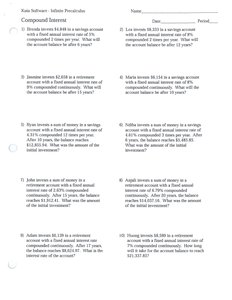
Q1. Brenda invests $4,310 in a savings account with a fixed annual interest rate of 5%, compounded 5 times per year. What will the account balance be after 6 years?
Background
Topic: Compound Interest
This question tests your understanding of how to calculate the future value of an investment using the compound interest formula, given the principal, interest rate, compounding frequency, and time.
Key formula:
Where:
= future value (account balance after years)
= principal (initial investment)
= annual interest rate (as a decimal)
= number of times interest is compounded per year
= number of years
Step-by-Step Guidance
Identify the known values: , , , .
Plug these values into the compound interest formula: .
Calculate to find the periodic interest rate.
Calculate to find the total number of compounding periods.
Try solving on your own before revealing the answer!
Final Answer:
After calculating the exponent and multiplying by the principal, the account balance after 6 years is .
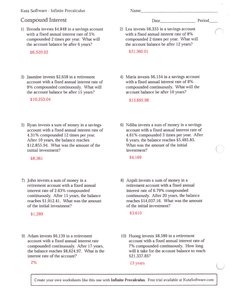
Q2. Lisa invests $6,330 in a savings account with a fixed annual interest rate of 8%, compounded 7 times per year. What will the account balance be after 4 years?
Background
Topic: Compound Interest
This question is similar to Q1, focusing on the effect of a higher interest rate and more frequent compounding periods.
Key formula:
Where:
Step-by-Step Guidance
Write out the formula with the values: .
Calculate for the periodic interest rate.
Calculate for the total number of compounding periods.
Set up the expression for the exponent and multiplication, but do not compute the final value yet.
Try solving on your own before revealing the answer!
Final Answer:
After calculating the exponent and multiplying by the principal, the account balance after 4 years is .
Q3. Jessica invests $2,510 in a retirement account with a fixed annual interest rate of 6% compounded 4 times per year. What will the account balance be after 15 years?
Background
Topic: Compound Interest
This question tests your ability to apply the compound interest formula over a longer time period, which demonstrates the power of compounding.
Key formula:
Where:
Step-by-Step Guidance
Substitute the values into the formula: .
Calculate for the periodic interest rate.
Calculate for the total number of compounding periods.
Set up the exponent and multiplication, but do not compute the final value yet.
Try solving on your own before revealing the answer!
Final Answer:
After calculating the exponent and multiplying by the principal, the account balance after 15 years is .
Q4. Maria invests $6,314 in a savings account with a fixed annual interest rate of 6%, compounded 6 times per year. What will the account balance be after 8 years?
Background
Topic: Compound Interest
This question is similar to previous ones, but with different values for principal, rate, compounding frequency, and time.
Key formula:
Where:
Step-by-Step Guidance
Substitute the values into the formula: .
Calculate for the periodic interest rate.
Calculate for the total number of compounding periods.
Set up the exponent and multiplication, but do not compute the final value yet.
Try solving on your own before revealing the answer!
Final Answer:
After calculating the exponent and multiplying by the principal, the account balance after 8 years is .
