 Back
Study Notes: Differentiation and Applications for College Algebra
Study Guide - Smart Notes
 Tailored notes based on your materials, expanded with key definitions, examples, and context.
Functions and Differentiation
Geometric Interpretation of the Derivative
The derivative of a function at a point provides the slope of the tangent line to the curve at that point. This is a fundamental concept in calculus and is essential for understanding rates of change in algebraic functions.
Slope of the Tangent Line: For a function at the point , the slope is given by:
Tangent Line Equation: The equation of the tangent line at is:
Interpretation: The tangent line represents the instantaneous rate of change of the function at a specific point.
Rate of Change
The rate of change describes how a quantity varies with respect to another. In algebra, this is often used to analyze functions and their behavior.
Average Rate of Change: Over an interval , the average rate is:
Instantaneous Rate of Change: At , the instantaneous rate is:
Definition of the Derivative
The derivative of a function at a number is defined as:
Alternative notation: (Newton), (Leibniz)
The derivative represents both the slope of the tangent and the instantaneous rate of change.
Derivatives of Fundamental Functions
Common derivatives include:
Applications in Economics: Marginal Quantity and Elasticity
Marginal Quantity
In economics, the marginal quantity refers to the additional change in a dependent variable when the independent variable increases by one unit.
For , when is small:
If , then
Marginal function:
Elasticity
Elasticity measures the percentage change in the dependent variable for a 1% change in the independent variable.
Elasticity at is:
Interpretation: If increases by 1%, changes by approximately percent.
Techniques of Differentiation
General Rules
(for )
Chain Rule
For ,
Leibniz notation:
Implicit Functions and Their Derivatives
Implicit Differentiation
Some functions are defined implicitly by equations involving both and . To find derivatives, differentiate both sides with respect to $x$, applying the chain rule as needed.
Example: If , differentiate to find .
To find higher-order derivatives, differentiate the resulting expression again.
Higher-Order Derivatives
Definition and Computation
Higher-order derivatives describe the rate of change of the derivative itself. The -th derivative is denoted or .
Compute successive derivatives to find patterns.
Use mathematical induction to prove general formulas.
Linear Approximation and Differentials
Linear Approximation
For near , a function can be approximated by its tangent line:
This is useful for estimating values and understanding local behavior.
Differentials
The differential approximates the change in for a small change in :
For ,
Generally, or
High-order differentials:
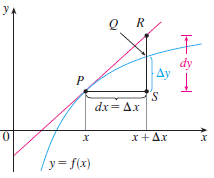
Additional info: The image illustrates the geometric relationship between the tangent line, the curve, and the increments , , and .
Applications: L'Hôpital's Rule
Indeterminate Forms and L'Hôpital's Rule
L'Hôpital's Rule is used to evaluate limits that result in indeterminate forms such as or .
If is indeterminate, then:
May need to apply the rule multiple times until the limit is determinate.
Extrema of Functions
Definitions
Extrema refer to the maximum and minimum values of a function, either locally or globally.
Local Maximum: is a local maximum if for all near .
Local Minimum: is a local minimum if for all near .
Global Maximum:
Global Minimum:
Finding Extrema
Necessary Condition: If has a local extremum at , then (stationary point).
First Derivative Test:
If changes from positive to negative at , has a local maximum.
If changes from negative to positive at , has a local minimum.
If does not change sign, no extremum at .
Second Derivative Test:
If and , has a local minimum at .
If and , has a local maximum at .
Steps to Find Extrema
Find stationary points by solving .
Apply the first or second derivative test at each stationary point.
For global extrema on , compare values at stationary points and endpoints.
Summary Table: Derivative Rules
Rule | Formula |
|---|---|
Constant Rule | |
Power Rule | |
Sum/Difference Rule | |
Product Rule | |
Quotient Rule | |
Chain Rule |
