 Back
BackTransformations of Functions in College Algebra
Study Guide - Smart Notes
 Tailored notes based on your materials, expanded with key definitions, examples, and context.
Transformations of Functions
Introduction to Function Transformations
Understanding how to manipulate and transform the graphs of basic functions is a fundamental skill in college algebra. Transformations allow us to shift, stretch, shrink, and reflect functions, making it easier to analyze and graph more complex equations.
Shifting: Adding or subtracting a constant moves the graph horizontally or vertically.
Stretching/Shrinking: Multiplying or dividing by a constant changes the graph's width or height.
Reflection: Multiplying by a negative reflects the graph across an axis.
Transformations affecting the x-coordinate (inside parentheses) act in the opposite direction to intuition, while those affecting the y-coordinate (outside the function) act as expected. The order of transformations is important: perform horizontal shifts first, then reflections and stretches/shrinks, and finally vertical shifts.
Standard Functions and Their Properties
Several standard functions serve as the basis for transformations. Their graphs and properties are essential for understanding how transformations affect them.
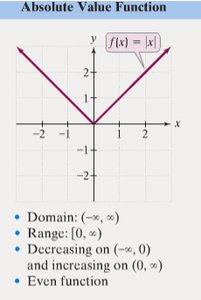
Absolute Value Function
The absolute value function is defined as . Its graph forms a 'V' shape, and it is commonly used to demonstrate transformations.
Domain:
Range:
Decreasing:
Increasing:
Even function: Symmetric about the y-axis
Standard Quadratic, Square Root, Cubic, and Cube Root Functions
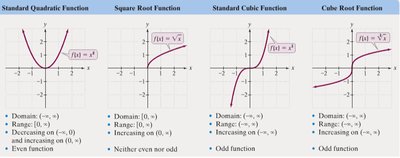
These functions are frequently used as the starting point for transformations:
Quadratic Function:
Domain:
Range:
Decreasing on , increasing on
Even function
Square Root Function:
Domain:
Range:
Increasing on
Neither even nor odd
Cubic Function:
Domain:
Range:
Increasing on
Odd function
Cube Root Function:
Domain:
Range:
Increasing on
Odd function
Identifying and Applying Transformations
To transform a function, follow these steps:
Identify the basic function (e.g., , , etc.).
Determine the transformations applied (shifts, stretches, reflections).
Order the transformations:
Perform horizontal (left/right) shifts first.
Apply reflections and stretches/shrinks next (order among these is unimportant).
Perform vertical (up/down) shifts last.
Create a table of values for the basic function.
Transform the table according to the identified transformations.
Graph the transformed function using the new table of values.
Example: Transforming
The inside the parentheses shifts the graph right by 3 units (affects x-coordinates).
The $4$ outside stretches the graph vertically by a factor of 4 (affects y-coordinates).
Apply these transformations to the table of values for to obtain the new graph.
Special Considerations for Radical Functions
When graphing radical functions, use "perfect" x-values to ensure the function is defined and easy to plot:
Square Root: Use perfect squares starting with 0 (e.g., 0, 1, 4, 9, 16).
Cube Root: Use perfect cubes starting with -8 (e.g., -8, -1, 0, 1, 8).
Summary Table: Standard Functions and Their Properties
Function | Domain | Range | Increasing/Decreasing | Even/Odd |
|---|---|---|---|---|
Absolute Value () | Decreasing , Increasing | Even | ||
Quadratic () | Decreasing , Increasing | Even | ||
Square Root () | Increasing | Neither | ||
Cubic () | Increasing | Odd | ||
Cube Root () | Increasing | Odd |
Additional info: The notes emphasize the importance of transformation order and the use of appropriate x-values for radical functions, which is crucial for accurate graphing and analysis in college algebra.
