Skip to main content
Financial Accounting
My Course
Learn
Exam Prep
AI Tutor
Study Guides
Flashcards
Explore
Try the app
My Course
Learn
Exam Prep
AI Tutor
Study Guides
Flashcards
Explore
Try the app
Back
Contingent Liabilities definitions
You can tap to flip the card.
Contingency
You can tap to flip the card.
👆
Contingency
Uncertain situation in accounting that may result in a gain or loss, depending on the outcome of a future event.
Track progress
Control buttons has been changed to "navigation" mode.
1/15
Related flashcards
Related practice
Recommended videos
Contingent Liabilities quiz #1
Contingent Liabilities
11 Terms
Contingent Liabilities
9. Current Liabilities
9 problems
Topic
Estimated Liabilities: Warranties
9. Current Liabilities
10 problems
Topic
9. Current Liabilities
7 topics
15 problems
Chapter
Guided course
07:27
Contingent Liabilities and Gains
987
views
22
rank
Terms in this set (15)
Hide definitions
Contingency
Uncertain situation in accounting that may result in a gain or loss, depending on the outcome of a future event.
Contingent Liability
Potential obligation arising from a past event, recognized if payment is probable and the amount can be estimated.
Contingent Gain
Possible benefit from an uncertain event, not recorded until it is realized due to accounting conservatism.
Accrual
Recording of an expense or liability in the financial statements before payment is made, based on probability and estimability.
Disclosure
Explanation provided in financial statement footnotes about uncertainties or risks not recognized as liabilities.
Footnotes
Sections in financial statements offering additional details about items such as contingencies and potential obligations.
Probability
Likelihood that a future event will require payment, categorized as probable, reasonably possible, or remote.
Estimability
Ability to reasonably determine the amount of a potential loss or obligation.
Probable
Classification indicating a high likelihood that a future event will result in a loss or payment.
Reasonably Possible
Classification for events with more than a remote but less than probable chance of resulting in a loss.
Remote
Classification for events with only a slight chance of resulting in a loss, requiring no action in financial statements.
Conservatism
Accounting principle favoring the recognition of potential losses over gains to avoid overstating financial health.
Legal Expense
Cost recognized when a probable and estimable loss from a legal case is accrued as a liability.
Financial Statements
Formal records, including balance sheet and footnotes, that present an entity’s financial position and disclosures.
Obligation
Potential or actual duty to pay or perform, often arising from past transactions or events.
 BackBack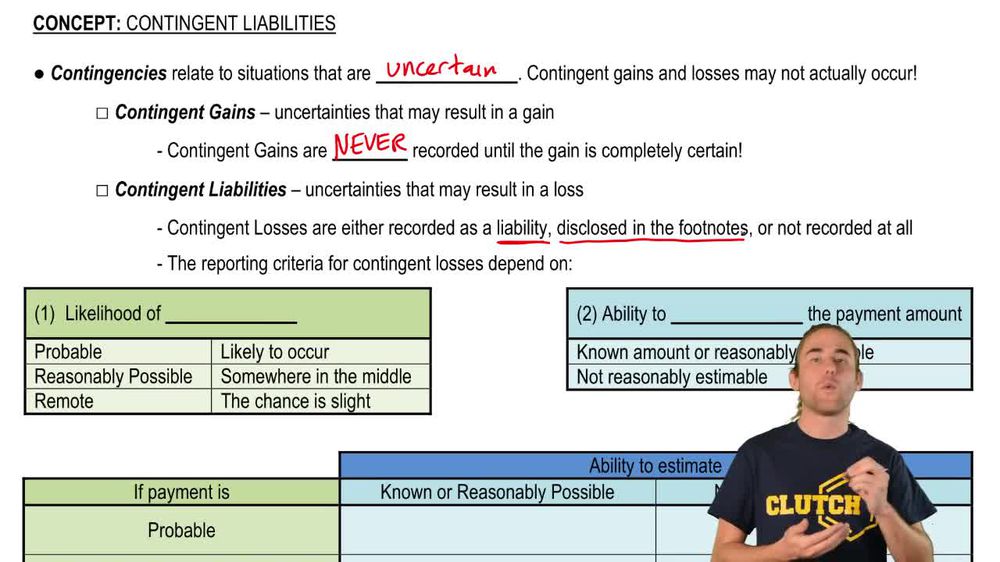
 07:27
07:27