Skip to main content
Financial Accounting
My Course
Learn
Exam Prep
AI Tutor
Study Guides
Flashcards
Explore
Try the app
My Course
Learn
Exam Prep
AI Tutor
Study Guides
Flashcards
Explore
Try the app
Back
Exchange for Similar Assets definitions
You can tap to flip the card.
Fixed Asset
You can tap to flip the card.
👆
Fixed Asset
Long-term tangible property used in business operations, such as vehicles or equipment, not intended for resale.
Track progress
Control buttons has been changed to "navigation" mode.
1/15
Related flashcards
Related practice
Recommended videos
Exchange for Similar Assets quiz
Exchange for Similar Assets
15 Terms
Exchange for Similar Assets
8. Long Lived Assets
10 problems
Topic
Asset Impairments
8. Long Lived Assets
9 problems
Topic
8. Long Lived Assets - Part 1 of 2
12 topics
13 problems
Chapter
8. Long Lived Assets - Part 2 of 2
1 topic
3 problems
Chapter
Guided course
11:54
Asset Exchanges
622
views
6
rank
Terms in this set (15)
Hide definitions
Fixed Asset
Long-term tangible property used in business operations, such as vehicles or equipment, not intended for resale.
Trade-In Value
Amount offered by a dealer or buyer for an old asset when exchanged for a new one, often differing from book value.
Net Book Value
Asset's original cost minus accumulated depreciation, representing its current value on the balance sheet.
Accumulated Depreciation
Total depreciation expense recorded against an asset since its purchase, reducing its book value.
Boot
Additional cash paid or received in an asset exchange, often used to balance the transaction.
Commercial Substance
Characteristic of a transaction that results in changes to future cash flows, making the exchange economically significant.
Journal Entry
Formal accounting record documenting the details of a transaction, including debits and credits.
Contra Asset
Account that offsets a related asset account, such as accumulated depreciation reducing equipment value.
Trade-In Allowance
Discount or credit given for an old asset when acquiring a new one, reducing the cash outlay required.
Gain
Positive difference when the trade-in value of an asset exceeds its net book value during an exchange.
Loss
Negative difference when the trade-in value of an asset is less than its net book value during an exchange.
List Price
Stated selling price of a new asset before any trade-in discounts or allowances are applied.
Notes Payable
Liability account representing amounts owed, possibly used instead of cash in asset exchanges.
Debit
Accounting entry that increases assets or expenses and decreases liabilities or equity.
Credit
Accounting entry that increases liabilities or equity and decreases assets or expenses.
 BackBack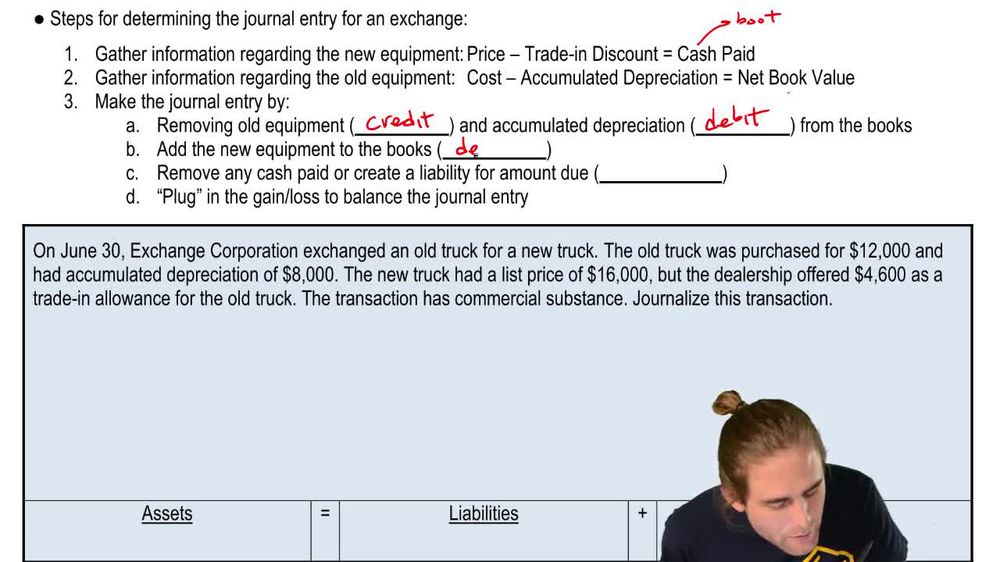
 11:54
11:54