Skip to main content
Financial Accounting
My Course
Learn
Exam Prep
AI Tutor
Study Guides
Flashcards
Explore
Try the app
My Course
Learn
Exam Prep
AI Tutor
Study Guides
Flashcards
Explore
Try the app
Back
GAAP vs. IFRS: Liabilities quiz
You can tap to flip the card.
Who sets the rules for GAAP in the United States?
You can tap to flip the card.
👆
Who sets the rules for GAAP in the United States?
The Financial Accounting Standards Board (FASB) sets the rules for GAAP in the United States.
Track progress
Control buttons has been changed to "navigation" mode.
1/15
Related flashcards
Related practice
Recommended videos
GAAP vs. IFRS: Liabilities definitions
GAAP vs. IFRS: Liabilities
15 Terms
GAAP vs. IFRS: Liabilities
15. GAAP vs IFRS
9 problems
Topic
GAAP vs. IFRS: Stockholders' Equity
15. GAAP vs IFRS
10 problems
Topic
15. GAAP vs IFRS
11 topics
11 problems
Chapter
Guided course
03:02
GAAP vs. IFRS: Liabilities
413
views
2
rank
Terms in this set (15)
Hide definitions
Who sets the rules for GAAP in the United States?
The Financial Accounting Standards Board (FASB) sets the rules for GAAP in the United States.
Who is responsible for creating IFRS internationally?
The International Accounting Standards Board (IASB) is responsible for creating IFRS.
How do both GAAP and IFRS define a liability?
Both define a liability as a future outflow of resources.
In what order are liabilities presented under GAAP and IFRS?
Liabilities are presented in order of liquidity under both GAAP and IFRS.
How might IFRS differ in presenting liabilities compared to GAAP?
IFRS may present liabilities in reverse liquidity, showing long-term liabilities before current liabilities.
What method is required by both GAAP and IFRS for bond premium amortization?
Both require the effective interest method for bond premium amortization.
What is a convertible bond?
A convertible bond is a bond that can be converted into shares of stock, starting as a liability.
Do GAAP and IFRS treat convertible bonds the same way?
No, there may be differences in accounting for convertible bonds between GAAP and IFRS.
What is the statement of financial position called under IFRS?
Under IFRS, the statement of financial position is equivalent to the balance sheet.
What calculation is often shown on the statement of financial position under IFRS?
Working capital is often shown on the statement of financial position under IFRS.
How is working capital calculated?
Working capital is calculated as current assets minus current liabilities.
Why is working capital important for investors?
It helps investors assess a company's liquidity and financial health.
Are there major differences in liability presentation between GAAP and IFRS?
No, there are not any major differences in liability presentation between GAAP and IFRS.
What type of liability are bonds payable considered?
Bonds payable are considered a long-term liability.
What information do you need to calculate working capital?
You need the current assets and current liabilities from the balance sheet.
 BackBack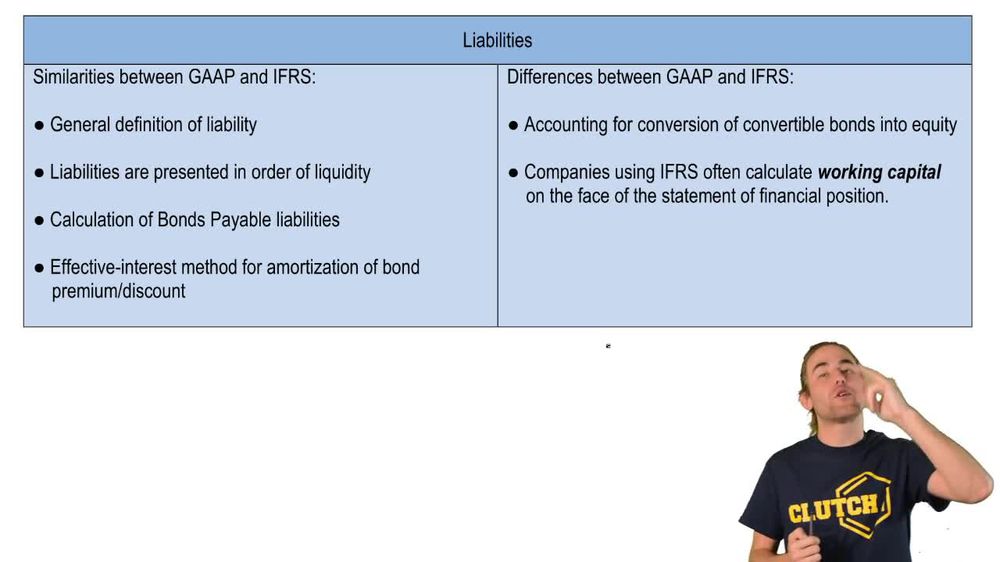
 03:02
03:02