What is the main purpose of calculating the ending balance in inventory in a perpetual inventory system?
The main purpose is to determine the final value of inventory on hand at the end of the period by continuously updating inventory records for all relevant transactions.
Which transactions increase the inventory account in a perpetual system?
Purchases of inventory increase the inventory account through debits.
Name three types of transactions that decrease the inventory account in a perpetual system.
Purchase discounts, purchase returns and allowances, and cost of goods sold (COGS) all decrease the inventory account.
What is the basic equation used to calculate the ending inventory balance in a perpetual system?
The equation is: Beginning Balance + Purchases - (Purchase Discounts + Purchase Returns and Allowances + COGS) = Ending Balance.
How does a T-account help in calculating the ending inventory balance?
A T-account visually separates increases (debits) and decreases (credits) to the inventory account, making it easier to calculate the ending balance.
In the provided example, what was the beginning inventory balance?
The beginning inventory balance was \$55,000.
How much were the purchases during the period in the example?
Purchases during the period were \$25,000.
What amount was recorded for purchase discounts in the example?
Purchase discounts totaled \$650.
What was the total for purchase returns and allowances in the example?
Purchase returns and allowances totaled \$1,500.
How much was the cost of goods sold (COGS) in the example?
COGS was \$40,000.
What was the calculated ending inventory balance in the example?
The ending inventory balance was \$37,850.
Does information about accounts payable directly affect the calculation of ending inventory in a perpetual system?
No, accounts payable information does not directly impact the inventory calculation.
Why are purchase discounts and purchase returns and allowances usually considered special cases?
They are special cases because most questions only involve COGS as a subtraction, but students should know how to handle discounts and returns if they appear.
What journal entry is typically made when inventory is purchased in a perpetual system?
A debit is made to inventory and a credit is made to accounts payable or cash.
How is the ending inventory balance determined using the T-account method?
Add all debits (beginning balance and purchases), subtract all credits (purchase discounts, returns and allowances, and COGS), and the result is the ending balance.
 Back
Back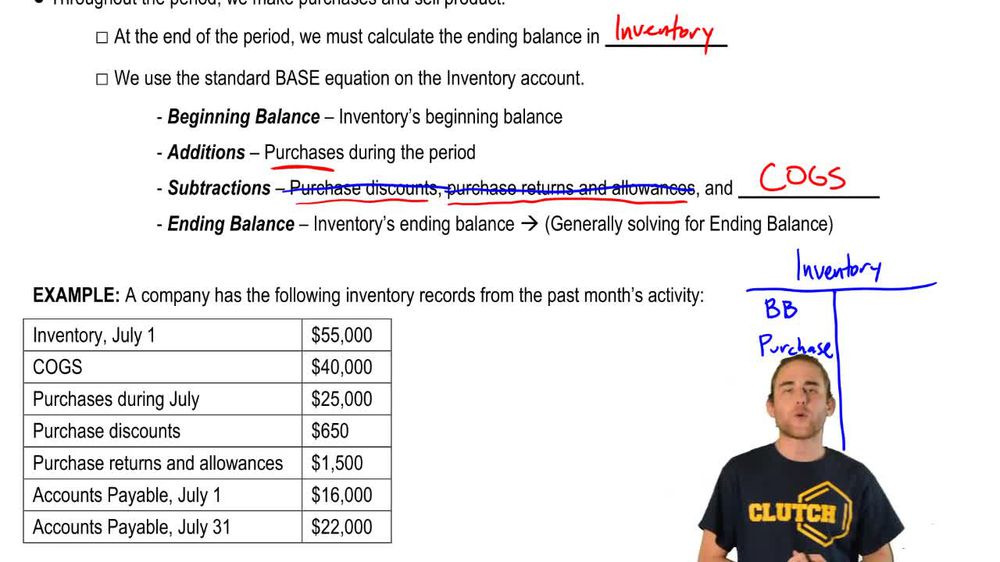
 06:37
06:37