Skip to main content
Financial Accounting
My Course
Learn
Exam Prep
AI Tutor
Study Guides
Flashcards
Explore
Try the app
My Course
Learn
Exam Prep
AI Tutor
Study Guides
Flashcards
Explore
Try the app
Back
Ratios: DuPont Model for Return on Equity (ROE) definitions
You can tap to flip the card.
Return on Equity
You can tap to flip the card.
👆
Return on Equity
Measures profitability by comparing net income to average common equity, indicating how effectively shareholder funds generate earnings.
Track progress
Control buttons has been changed to "navigation" mode.
1/13
Related flashcards
Related practice
Recommended videos
Ratios: DuPont Model for Return on Equity (ROE) quiz #1
Ratios: DuPont Model for Return on Equity (ROE)
10 Terms
Ratios: DuPont Model for Return on Equity (ROE)
14. Financial Statement Analysis
10 problems
Topic
Ratios: Free Cash Flow
14. Financial Statement Analysis
10 problems
Topic
14. Financial Statement Analysis
15 topics
15 problems
Chapter
Guided course
09:24
Ratios: DuPont Model for Return on Equity (ROE)
988
views
10
rank
Terms in this set (13)
Hide definitions
Return on Equity
Measures profitability by comparing net income to average common equity, indicating how effectively shareholder funds generate earnings.
DuPont Model
Analytical framework that breaks down return on equity into three components to reveal underlying drivers of profitability.
Profit Margin
Shows net income earned per dollar of sales, highlighting how much profit remains after all expenses are deducted from revenue.
Total Asset Turnover
Indicates efficiency by showing how many dollars of sales are generated for each dollar invested in assets.
Equity Multiplier
Reflects financial leverage by comparing average total assets to average common equity, revealing reliance on debt.
Leverage Ratio
Alternative name for equity multiplier, emphasizing the extent to which a company uses debt to finance assets.
Net Income
Represents the residual earnings after all expenses, taxes, and costs are subtracted from total revenue.
Average Common Equity
Represents the mean value of common shareholders' equity over a period, used as a base for profitability ratios.
Net Sales
Total revenue from goods or services sold, minus returns, allowances, and discounts.
Return on Assets
Shows how efficiently a company uses its assets to generate net income, calculated as net income over average total assets.
Liabilities
Obligations or debts a company must repay, which, along with equity, finance the company's assets.
Common Shareholders
Owners of a company's common stock, whose equity is the focus in return on equity calculations.
Net Loss
Occurs when total expenses exceed total revenue, resulting in negative net income and potentially negative return on equity.
 BackBack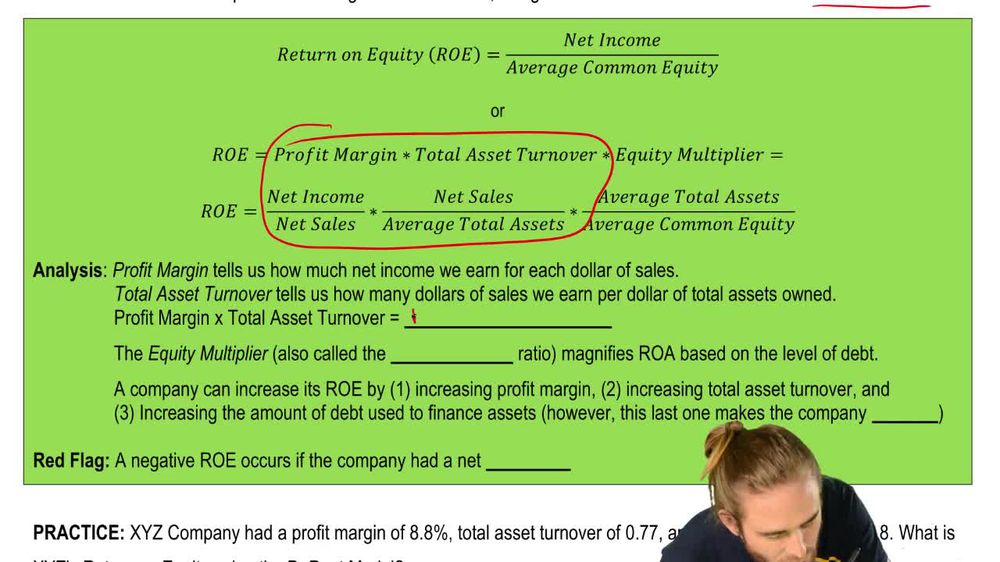
 09:24
09:24