Skip to main content
Financial Accounting
My Course
Learn
Exam Prep
AI Tutor
Study Guides
Flashcards
Explore
Try the app
My Course
Learn
Exam Prep
AI Tutor
Study Guides
Flashcards
Explore
Try the app
Back
Ratios: Earnings Per Share (EPS) definitions
You can tap to flip the card.
Earnings Per Share
You can tap to flip the card.
👆
Earnings Per Share
A profitability ratio showing the portion of a company's net income allocated to each share of common stock.
Track progress
Control buttons has been changed to "navigation" mode.
1/14
Related flashcards
Related practice
Recommended videos
Ratios: Earnings Per Share (EPS) quiz #1
Ratios: Earnings Per Share (EPS)
20 Terms
Ratios: Earnings Per Share (EPS)
14. Financial Statement Analysis
10 problems
Topic
Ratios: Working Capital and the Current Ratio
14. Financial Statement Analysis
10 problems
Topic
14. Financial Statement Analysis
15 topics
15 problems
Chapter
Guided course
05:39
Ratios: Earnings Per Share (EPS)
1362
views
23
rank
Terms in this set (14)
Hide definitions
Earnings Per Share
A profitability ratio showing the portion of a company's net income allocated to each share of common stock.
EPS
A common abbreviation for the ratio that measures income earned per share of common stock.
Income Statement
A financial report where net income and earnings per share are displayed, typically at the bottom.
Net Income
The total profit of a company after all expenses, used as the starting point for calculating EPS.
Preferred Dividends
Payments made to preferred stockholders before any earnings are distributed to common stockholders.
Common Stock
Equity shares representing ownership in a company, whose holders are entitled to earnings per share.
Average Number of Shares
The mean of beginning and ending balances of common shares outstanding, used in the EPS denominator.
Profitability Ratio
A financial metric used to assess a company's ability to generate earnings relative to its revenue or assets.
Basic EPS
The standard calculation of earnings per share, excluding potential dilution from convertible securities or options.
Diluted EPS
A more complex version of EPS that accounts for possible increases in shares from options or convertible debt.
Convertible Debt
A type of bond or loan that can be exchanged for a predetermined number of common shares, potentially affecting EPS.
Employee Stock Options
Contracts granting employees the right to purchase company shares, which can increase the total shares outstanding.
Outstanding Shares
The total number of common shares currently held by shareholders and used in EPS calculations.
Trend Analysis
The process of evaluating changes in EPS over time to assess a company's financial performance.
 BackBack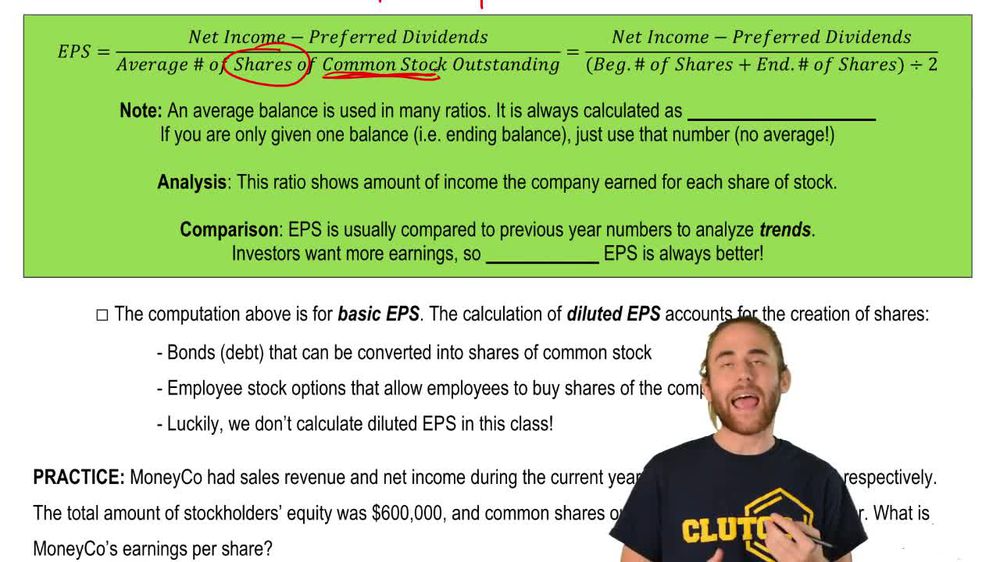
 05:39
05:39