How does the PE ratio reflect market expectations?
A higher PE ratio reflects higher market expectations for future earnings growth.
What type of stock would typically have a higher PE ratio, a growth stock or a value stock?
A growth stock would typically have a higher PE ratio due to expectations of higher future earnings.
If a company’s PE ratio is significantly higher than the industry average, what might this indicate?
It may indicate that investors expect the company to have higher future earnings growth compared to its peers.
What is the impact on the PE ratio if the market price increases but earnings per share remain the same?
The PE ratio will increase if the market price increases while EPS remains unchanged.
What is the impact on the PE ratio if earnings per share increase but the market price stays the same?
The PE ratio will decrease if EPS increases while the market price remains the same.
Why is it important to use the average number of shares outstanding when calculating EPS?
Using the average number of shares accounts for changes in the number of shares during the period, providing a more accurate EPS.
How do you calculate the Price-Earnings (PE) ratio using information from the balance sheet and related financial statements?
To calculate the Price-Earnings (PE) ratio, first determine earnings per share (EPS) by subtracting preferred dividends from net income and dividing by the average number of common shares outstanding (average = (beginning shares + ending shares) / 2). Then, divide the current market price per share by the EPS: PE ratio = Market Price per Share / Earnings per Share.
 Back
Back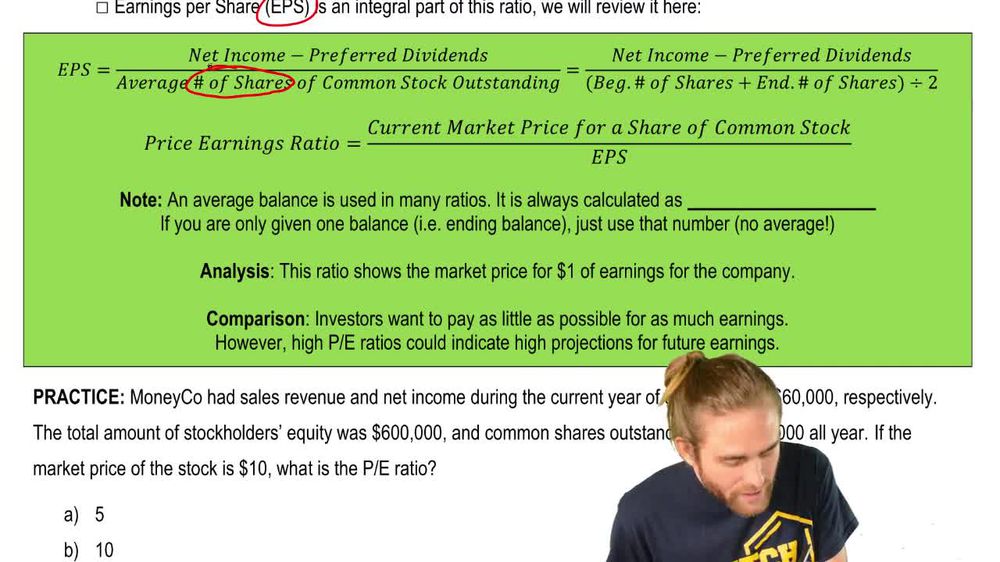
 04:15
04:15