Skip to main content
Financial Accounting
My Course
Learn
Exam Prep
AI Tutor
Study Guides
Flashcards
Explore
Try the app
My Course
Learn
Exam Prep
AI Tutor
Study Guides
Flashcards
Explore
Try the app
Back
Redeeming Bonds before Maturity quiz
You can tap to flip the card.
What does it mean when a company redeems bonds before maturity?
You can tap to flip the card.
👆
What does it mean when a company redeems bonds before maturity?
It means the company repurchases its bonds before their scheduled maturity date, removing the liability from its books.
Track progress
Control buttons has been changed to "navigation" mode.
1/15
Related flashcards
Related practice
Recommended videos
Redeeming Bonds before Maturity definitions
Redeeming Bonds before Maturity
15 Terms
Redeeming Bonds before Maturity
11. Long Term Liabilities
10 problems
Topic
Effective Interest Amortization of Bond Premium or Discount
11. Long Term Liabilities
7 problems
Topic
11. Long Term Liabilities
8 topics
13 problems
Chapter
Guided course
09:36
Redeeming Bonds Before Maturity
844
views
17
rank
Guided course
04:20
Redeeming Bonds Before Maturity
569
views
16
rank
Terms in this set (15)
Hide definitions
What does it mean when a company redeems bonds before maturity?
It means the company repurchases its bonds before their scheduled maturity date, removing the liability from its books.
Why might a company choose to redeem its bonds early?
A company might redeem bonds early to stop paying interest or to take advantage of lower market interest rates.
How is the carrying value of a bond calculated?
Carrying value is the face value of the bond minus any unamortized discount or plus any unamortized premium.
What results when the repurchase price of a bond is higher than its carrying value?
A loss on retirement of bonds is recorded when the repurchase price exceeds the carrying value.
What results when the repurchase price of a bond is lower than its carrying value?
A gain on retirement of bonds is recorded when the repurchase price is less than the carrying value.
Where is the gain or loss on bond retirement reported?
The gain or loss on retirement is reported on the income statement.
What is the journal entry to remove bonds payable when bonds are retired?
You debit bonds payable for the face value to remove the liability from the books.
How do you remove the remaining discount on bonds payable during retirement?
You credit the discount on bonds payable for the remaining unamortized amount.
What is the journal entry for cash when bonds are repurchased?
You credit cash for the amount paid to repurchase the bonds.
How do you calculate the amount of gain or loss on bond retirement?
Subtract the carrying value of the bonds from the repurchase price; a positive result is a loss, and a negative result is a gain.
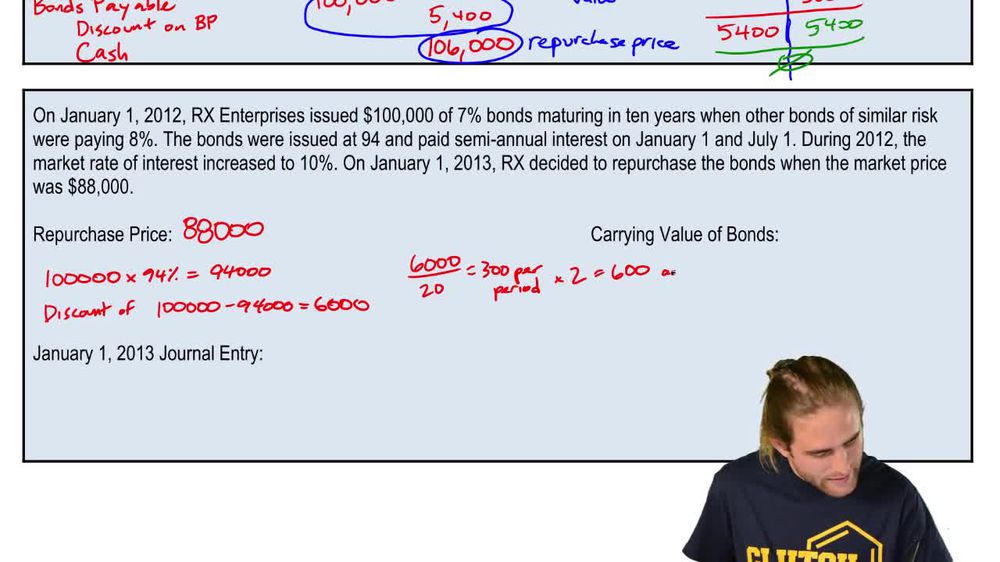
In the RX Enterprises example, what was the loss when bonds were repurchased for \$106,000 with a carrying value of \$94,600?
The loss was \$11,400, calculated as \$106,000 minus \$94,600.
In the RX Enterprises example, what was the gain when bonds were repurchased for \$88,000 with a carrying value of \$94,600?
The gain was \$6,600, calculated as \$94,600 minus \$88,000.
How is the discount on bonds amortized if interest is paid semiannually?
The total discount is divided by the number of interest periods (years times two) and amortized each period.
What type of account balance does a loss on bond retirement have?
A loss on retirement has a debit balance, similar to an expense.
What type of account balance does a gain on bond retirement have?
A gain on retirement has a credit balance, similar to revenue.
 BackBack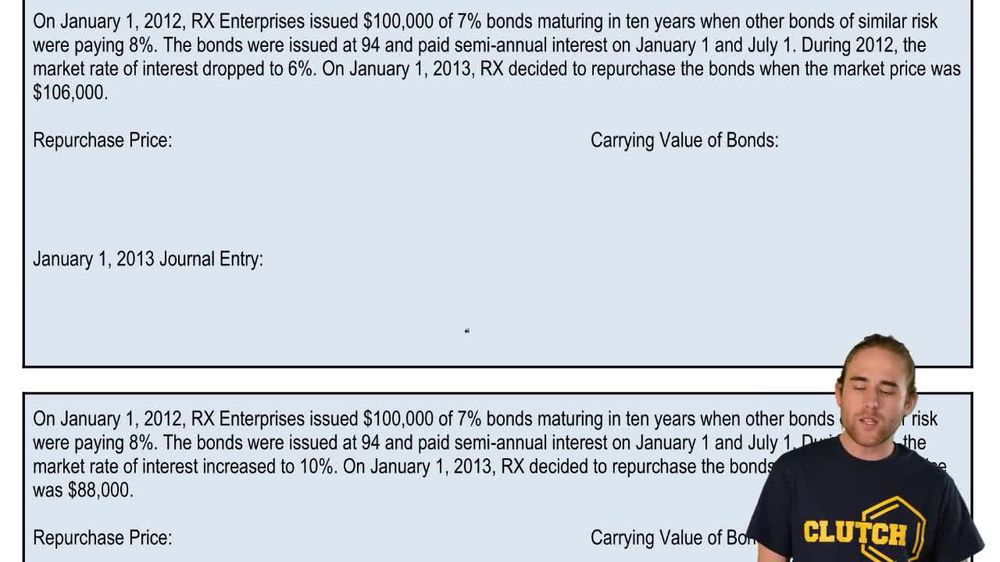
 09:36
09:36