 Back
Chapter 1: Financial Statements – Structured Study Notes for Financial Accounting
Study Guide - Smart Notes
 Tailored notes based on your materials, expanded with key definitions, examples, and context.
Financial Accounting: Chapter 1 – Financial Statements
Introduction to Financial Accounting
Financial accounting is the process of recording, summarizing, and reporting the myriad of transactions resulting from business operations over a period of time. It is essential for providing information to decision makers both inside and outside the organization.
Learning Objectives
Explain why accounting is critical to business
Apply underlying accounting concepts, assumptions, and principles
Apply the accounting equation to business organizations
Construct financial statements and analyze their relationships
Evaluate business decisions ethically
Identify the role of accounting in ESG practices
Describe career paths and certifications in accounting
Identify tools and technologies used in accounting
Why Accounting Is Critical to Business
Accounting as an Information System
Accounting measures business activities, processes data into financial statements and reports, and communicates results to decision makers. The accounting cycle is the process by which financial statements are prepared.
Measures business activities
Processes data into financial statements
Communicates results to decision makers
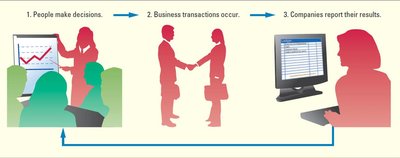
Decision Makers Who Use Accounting
Individuals
Investors and creditors
Regulatory bodies
Nonprofit organizations
Types of Accounting
Financial Accounting: For external users (investors, creditors, government agencies, public)
Managerial Accounting: For internal users (managers, budgets, forecasts, projections)
Business Organization Structures
Forms of Business Organization
Type | Owner(s) | Personal Liability |
|---|---|---|
Proprietorship | One | Unlimited |
Partnership | Two or more | General partners: unlimited; limited partners: limited |
LLC | One or more (members) | Limited |
Corporation | Stockholders | Limited |
Corporation: Can raise large sums of capital, offers limited liability, but faces double taxation.
Accounting Concepts, Assumptions, and Principles
Professional Frameworks
GAAP: Generally Accepted Accounting Principles (US)
IFRS: International Financial Reporting Standards (global)
Conceptual Foundation of Accounting
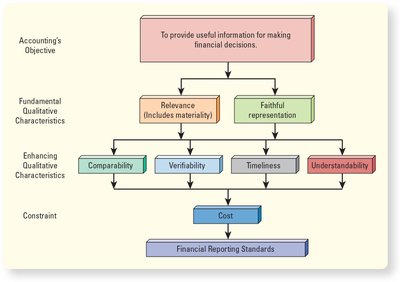
Accounting information must be relevant and faithfully represented. Enhancing characteristics include comparability, verifiability, timeliness, and understandability. Cost is a constraint.
Key Assumptions and Principles
Entity Assumption: Business is a separate economic unit
Continuity (Going-Concern) Assumption: Entity will continue to operate
Historical Cost Principle: Assets recorded at actual cost
Stable-Monetary-Unit Assumption: Dollar’s purchasing power is stable
The Accounting Equation
Basic Equation
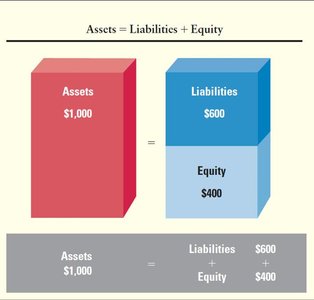
The accounting equation shows the relationship among assets, liabilities, and equity. It is the foundation of all financial accounting.
Assets: Economic resources expected to produce future benefit
Liabilities: Debts owed to outsiders
Equity: Owners’ claims on assets
Equation:
Expanded Equation
For corporations:
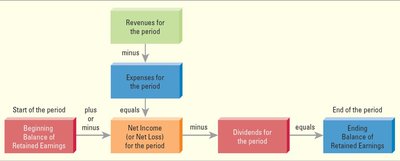
Components of Retained Earnings
Revenues: Inflow from delivering goods/services; increases retained earnings
Expenses: Outflow due to operations; decreases retained earnings
Dividends: Distribution to stockholders; decreases retained earnings
Gains: Inflow from activities outside main business; increases retained earnings
Losses: Outflow from activities outside main business; decreases retained earnings
Financial Statements and Their Relationships
Overview of Financial Statements
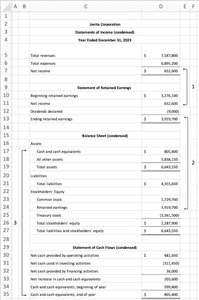
Data flows from one financial statement to the next, creating a logical sequence for reporting financial information.

Types of Financial Statements
Statement | Purpose | Key Equation |
|---|---|---|
Income Statement | Performance over a period | |
Statement of Retained Earnings | Changes in retained earnings | |
Balance Sheet | Financial position at a point in time | |
Statement of Cash Flows | Cash inflows and outflows |
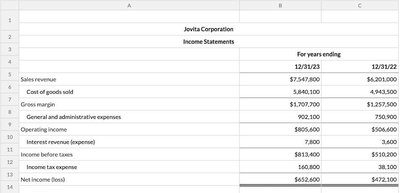
Income Statement Example
The income statement reports revenues, expenses, and net income for a period. Below is an example for Jovita Corporation:
Item | 12/31/23 | 12/31/22 |
|---|---|---|
Sales revenue | $7,547,800 | $6,201,000 |
Cost of goods sold | $5,840,100 | $4,921,500 |
Gross margin | $1,707,700 | $1,279,500 |
General and administrative expenses | $902,700 | $730,700 |
Operating income | $805,000 | $506,800 |
Interest revenue (expense) | $7,800 | $4,400 |
Income before taxes | $813,400 | $511,200 |
Income tax expense | $160,800 | $39,100 |
Net income (loss) | $652,600 | $472,100 |
Statement of Retained Earnings Example
Shows how retained earnings change over a period:
Beginning retained earnings
Add: Net income (loss)
Less: Dividends declared
Ending retained earnings
Balance Sheet Example
Reports assets, liabilities, and stockholders' equity at a specific date.
Current assets: Cash, receivables, inventories, prepaid expenses
Long-term assets: Property, plant, equipment, investments, intangibles
Current liabilities: Accounts payable, salaries payable, short-term notes
Long-term liabilities: Long-term notes, bonds payable
Equity: Common stock, retained earnings, treasury stock
Statement of Cash Flows Example
Reports cash receipts and payments from operating, investing, and financing activities.
Relationships Among Financial Statements
Financial statements are interconnected. Net income from the income statement flows to the statement of retained earnings, which then affects the balance sheet. The statement of cash flows summarizes cash changes reflected in the balance sheet.
Ethical Decision Making in Accounting
Three Influences on Decisions
Economic: Maximize economic benefits
Legal: Follow laws and regulations
Ethical: Consider what is right beyond legal and economic factors
AICPA Code of Professional Conduct
Responsibilities
Public Interest
Integrity
Objectivity and Independence
Due Care
Scope and Nature of Services
Accounting and ESG Practices
ESG Reporting Frameworks
Global Reporting Initiative (GRI)
International Sustainability Standards Board (ISSB)
United Nations Global Compact (UNGC)
Task Force on Climate-Related Financial Disclosures (TCFD)
ESG measures include environmental, social, and governance factors such as energy consumption, water usage, renewable energy percentage, emissions, and waste.
Accountants' Role in ESG
Third-party assurance for ESG reports
Internal ESG reporting and analysis
Recommendations for reducing carbon footprint and improving supplier diversity
Career Paths and Certifications in Accounting
Career Path Options
External auditor
Management accountant
Internal auditor
Budget analyst
Financial analyst
Professional Certifications
CPA (Certified Public Accountant)
CMA (Certified Management Accountant)
CGMA (Chartered Global Management Accountant)
CIA (Certified Internal Auditor)
CFE (Certified Fraud Examiner)
The CPA Exam
Four-section, 16-hour format
Core sections: accounting, auditing, tax
Discipline options: Business Analysis and Reporting, Information Systems and Controls, Tax Compliance and Planning
Tools and Technologies in Accounting
Spreadsheets
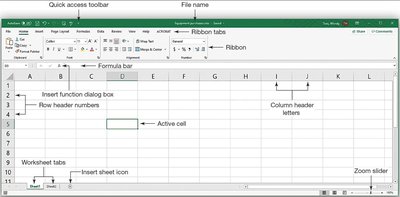
Spreadsheets (e.g., Microsoft Excel, Google Sheets, Apple Numbers) are used to organize data, perform calculations, and generate graphs.
Data Analytics
Analyzing raw data to produce insights
Discovering trends, process improvements, investment decisions
Artificial Intelligence and Machine Learning
AI: Programs and machines that solve problems creatively
Machine Learning: Machines learn from data without explicit programming
Robotic Process Automation (RPA)
Software bots perform routine tasks
Accountants focus on analysis and interpretation
Technology Risks
Proper use facilitates better decisions
Improper use can lead to catastrophic outcomes
Summary Table: Financial Statement Relationships
Statement | Flows Into |
|---|---|
Income Statement | Statement of Retained Earnings |
Statement of Retained Earnings | Balance Sheet |
Balance Sheet | Statement of Cash Flows |
Additional info: These notes expand on brief points from the slides and images, providing academic context, definitions, and examples for clarity and completeness.
