 Back
BackChapter 2: Financial Reporting Theory – Study Notes
Study Guide - Smart Notes
 Tailored notes based on your materials, expanded with key definitions, examples, and context.
Financial Reporting Theory
Overview of the Conceptual Framework
The conceptual framework in accounting provides a theoretical foundation for the development and application of accounting standards. It ensures that standards are coherent, consistent, and based on sound principles. The framework assists standard setters in developing and revising accounting standards but does not override existing standards.
Purpose: To guide the creation and revision of accounting standards.
Components: Objectives of financial reporting, reporting entity, qualitative characteristics, elements of financial statements, recognition and derecognition.
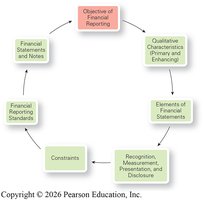
Objectives of Financial Reporting
The main objective of financial reporting is to provide useful financial information about the reporting entity to existing and potential investors, lenders, and other creditors for decision-making purposes. These users cannot demand information directly from the entity and rely on published financial statements.
Primary Users: Investors, lenders, and other creditors.
IFRS Addition: Financial information also helps assess management’s stewardship of the entity’s resources.
Qualitative Characteristics of Financial Information
Qualitative characteristics determine the usefulness of financial information. They are divided into fundamental and enhancing characteristics, with a cost constraint considered in providing information.
Fundamental Characteristics: Relevance and faithful representation.
Enhancing Characteristics: Comparability, verifiability, timeliness, and understandability.
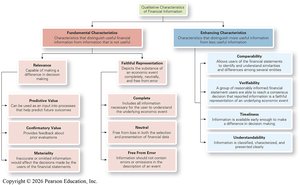
Relevance
Predictive Value: Helps users forecast future outcomes.
Confirmatory Value: Provides feedback on prior evaluations.
Materiality: Information that would influence decisions if omitted or misstated.
Faithful Representation
Complete: Includes all necessary information.
Neutral: Free from bias.
Free from Error: No mistakes or omissions in the description or process.
Enhancing Characteristics
Comparability: Enables users to identify similarities and differences among entities.
Verifiability: Different knowledgeable users can reach consensus on the information’s faithful representation.
Timeliness: Information is available in time to influence decisions.
Understandability: Information is clearly classified and presented for informed users.
Cost Constraint
Providing all relevant and faithfully represented information can be costly. Standard setters must weigh the benefits of information against the costs to preparers and users.
Elements of Financial Reporting
Elements are the building blocks of financial statements. They are classified as point-in-time or period-of-time elements.
Point-in-Time Elements: Assets, liabilities, equity (appear on the balance sheet).
Period-of-Time Elements (U.S. GAAP): Revenues, expenses, gains, losses, investments by owners, distributions to owners, comprehensive income.
Period-of-Time Elements (IFRS): Income (revenues and gains), expenses (expenses and losses).
Recognition and Derecognition in Financial Reporting
Recognition is the process of including an item in the financial statements, while derecognition is its removal. Accrual accounting is used, recognizing revenues and expenses when earned or incurred, not when cash is received or paid.
Recognition Criteria: Meets definition of an element, measurable, faithfully represented, relevant (IFRS adds relevance).
Derecognition: Occurs when an asset or liability no longer meets its definition.
Revenue Recognition Principle
Revenue is recognized when it is realized or realizable and earned. The five-step model for revenue recognition is:
Identify the contract with the customer.
Identify the separate performance obligations.
Determine the transaction price.
Allocate the transaction price to performance obligations.
Recognize revenue when each obligation is satisfied.
Expense Recognition Principles
Expenses are recognized when assets are consumed or liabilities incurred in delivering goods or services. Three approaches are used:
Direct association with revenues (e.g., cost of goods sold).
Expense in the period incurred (e.g., salaries).
Systematic allocation over periods (e.g., depreciation).
Cash vs. Accrual Accounting
Cash-basis accounting recognizes revenues and expenses only when cash is received or paid. Accrual accounting recognizes them when earned or incurred, providing a more accurate measure of economic activity.
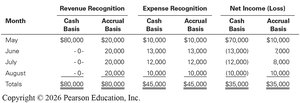
Example: Yards, Inc. receives $80,000 in May for services to be performed over four months. Under cash-basis, all revenue is recognized in May; under accrual, revenue is recognized evenly over the four months, matching the service period.
Measurement in Financial Reporting
Measurement bases determine how elements are quantified in financial statements. U.S. GAAP identifies five bases:
Historical Cost: Original transaction amount, adjusted for depreciation/amortization.
Current Cost: Amount required to acquire the asset currently.
Current Market Value: Amount received in an orderly liquidation.
Net Realizable Value: Cash expected from asset disposal, less costs.
Present Value of Future Cash Flows: Discounted expected net cash flows.
IFRS uses historical cost and current value (including fair value, value in use, and fulfillment value).
Presentation and Disclosure
Notes to the financial statements provide additional information about line items, the reporting entity, and events or conditions not yet recognized but potentially affecting cash flows. Effective disclosure focuses on objectives and principles, classifies and aggregates information appropriately, and avoids excessive detail.
Capital and Capital Maintenance (IFRS)
Capital maintenance assesses changes in equity. Two concepts exist:
Financial Capital Maintenance: Capital is the monetary investment in the company.
Physical Capital Maintenance: Capital is the productive capacity (e.g., units of output).
Capital maintenance adjustments (e.g., revaluations) are not reported in net income.
Assumptions in Financial Reporting
Several underlying assumptions support financial reporting:
Going Concern: The entity will continue operating indefinitely.
Economic Entity: The business is separate from its owners.
Monetary Unit: All items are measured in a stable currency.
Periodicity: The entity’s life is divided into reporting periods (e.g., quarters, years).
