 Back
BackConstruction Financial Management: Principles and Practices
Study Guide - Smart Notes
 Tailored notes based on your materials, expanded with key definitions, examples, and context.
Construction Financial Management
Introduction to Construction Financial Management
Construction financial management is a specialized branch of financial management focused on the unique needs and challenges of construction companies. Unlike other industries, construction firms face project-based operations, decentralized management, and complex payment structures.
Definition: Financial management is the strategic use of a company’s financial resources, including cash and assets, to achieve business objectives.
Key Resources: Cash, equipment, and other assets.
Industry Challenges: Unique projects, changing locations, progress payments, retention, and heavy reliance on subcontractors.
Business Failure Rates in Construction
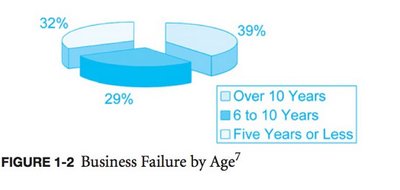
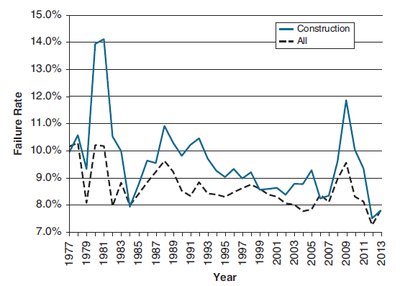
Construction companies experience higher failure rates compared to other industries, often due to ineffective financial management.
Survival Rates: The percentage of companies surviving decreases significantly over time.
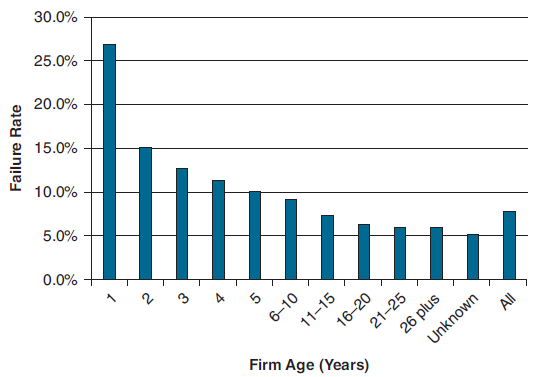
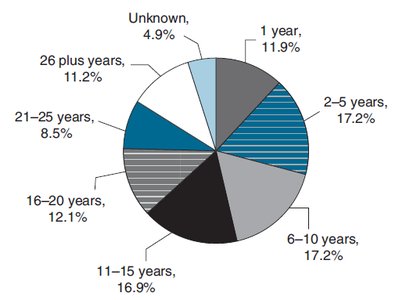
Failure by Firm Age: Younger firms are more likely to fail than older firms.

Reasons for Construction Company Failure
Construction companies often fail due to a combination of financial and managerial shortcomings.
Ineffective financial management systems
Overextended lines of credit
Poor estimating and job cost reporting
Poor project management
Lack of comprehensive business plan
Communication problems
What is Financial Management?
Financial management involves the planning, organizing, directing, and controlling of financial activities such as procurement and utilization of funds.
Cash Management: Ensuring sufficient liquidity for operations.
Asset Management: Tracking and optimizing the use of equipment and other assets.
Unique Features of Construction Financial Management
Project-Oriented: Each project is unique, making cost determination and job cost accounting more complex.
Decentralized Operations: Equipment and resources must be tracked across multiple locations.
Payment Terms: Progress payments and retention are common, affecting cash flow.
Subcontractor Use: Heavy reliance on subcontractors requires careful financial oversight.
Roles and Responsibilities in Construction Financial Management
Multiple stakeholders are responsible for financial management in construction companies.
Owners
General Managers
CFO (Chief Financial Officer)
Estimators
Project Managers
Superintendents
Functions of a Financial Manager
Financial managers play a critical role in ensuring the financial health of construction companies.
Accounting for Financial Resources: Accurate tracking of costs and proper functioning of accounting systems.
Managing Costs and Profits: Monitoring project and company profitability, setting labor burden markups, and developing overhead budgets.
Managing Cash Flows: Matching labor and subcontractor use to available cash, preparing cash flow projections, and arranging financing.
Choosing Financial Alternatives: Deciding on equipment purchases and investment areas.
Accounting for Financial Resources
Cost Tracking: Ensuring costs are accurately tracked through the accounting system.
Financial Statement Preparation: Preparing and reviewing financial statements to identify potential problems.
Project Cost Projection: Estimating costs at completion, including unbilled committed costs.
Billing Analysis: Determining whether projects are over- or underbilled.
Managing Costs and Profits
Cost Control: Monitoring and controlling project costs.
Profitability Analysis: Analyzing profitability by project, customer, and company segment.
Budgeting: Setting labor burden markups and tracking overhead budgets.
Minimum Profit Margin: Establishing minimum profit margins for bidding.
Managing Cash Flows
Cash Flow Projection: Preparing and updating annual cash flow projections.
Financing: Arranging for financing to cover company needs.
Income Tax Projection: Preparing income tax projections for the company.
Choosing Among Financial Alternatives
Equipment Selection: Deciding which equipment to purchase based on financial analysis.
Investment Decisions: Choosing which areas of the business to invest limited resources.
Conclusion
Operating a successful construction company requires specialized financial management skills due to the unique nature of the industry. Effective financial management helps mitigate risks and improve the likelihood of business survival.
Key Formulas and Concepts
Profit Margin:
Cash Flow Projection:
Over/Underbilling:
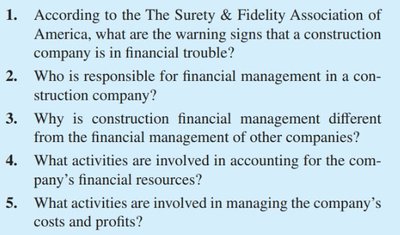
Homework and Study Questions
Warning signs of financial trouble in construction companies
Roles responsible for financial management
Differences between construction and other industries in financial management
Activities involved in accounting for financial resources
Activities involved in managing costs and profits
Activities involved in managing cash flows
Examples of financial decisions construction managers must make
Additional info:
Construction accounting often requires specialized software and systems to track project costs, manage billing, and ensure compliance with industry standards.
Retention refers to a portion of payment withheld until project completion to ensure quality and fulfillment of contract terms.
