 Back
BackCost-Volume-Profit Analysis: Contribution Margin and Operating Income
Study Guide - Smart Notes
 Tailored notes based on your materials, expanded with key definitions, examples, and context.
Q1. What is the company's contribution margin per unit?
Background
Topic: Contribution Margin Calculation
This question tests your understanding of how to calculate the contribution margin per unit, which is a key concept in cost-volume-profit analysis. The contribution margin per unit shows how much revenue from each unit sold is available to cover fixed costs and generate profit after variable costs are paid.
Key formula:
Sales Price per Unit: The price at which each unit is sold.
Variable Cost per Unit: The sum of all variable costs associated with producing one unit.
Step-by-Step Guidance
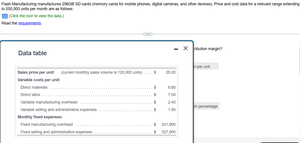
Identify the sales price per unit from the data table.
Sum all variable cost components per unit (direct materials, direct labor, variable manufacturing overhead, variable selling & administrative expenses).
Subtract the total variable cost per unit from the sales price per unit to find the contribution margin per unit.
Try solving on your own before revealing the answer!
Final Answer: $7.10 per unit
This means that for each unit sold, $7.10 is available to cover fixed costs and generate profit.
Q2. What is the company's contribution margin percentage?
Background
Topic: Contribution Margin Ratio
This question tests your ability to calculate the contribution margin ratio, which shows what percentage of each sales dollar is available to cover fixed costs and profit after variable costs are paid.
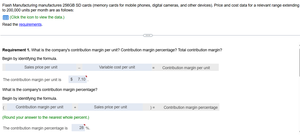
Key formula:
Contribution Margin per Unit: The amount calculated in Q1.
Sales Price per Unit: The price at which each unit is sold.
Step-by-Step Guidance
Take the contribution margin per unit from the previous calculation.
Divide the contribution margin per unit by the sales price per unit.
Convert the result to a percentage by multiplying by 100.
Try solving on your own before revealing the answer!
Final Answer: 28%
This means that 28% of each sales dollar is available to cover fixed costs and profit.
Q3. What is the company's total contribution margin?
Background
Topic: Total Contribution Margin
This question tests your ability to calculate the total contribution margin, which is the total amount available to cover fixed costs and profit for a given sales volume.
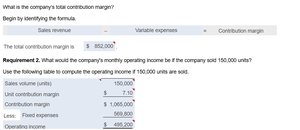
Key formula:
Contribution Margin per Unit: The amount calculated in Q1.
Sales Volume: The number of units sold.
Step-by-Step Guidance
Identify the contribution margin per unit.
Identify the sales volume (number of units sold).
Multiply the contribution margin per unit by the sales volume to find the total contribution margin.
Try solving on your own before revealing the answer!
Final Answer: $852,000
This is the total amount available to cover fixed costs and generate profit for the current sales volume.
Q4. What would the company's monthly operating income be if the company sold 150,000 units?
Background
Topic: Operating Income Calculation
This question tests your ability to calculate operating income by subtracting fixed expenses from the total contribution margin for a given sales volume.
Key formula:
Total Contribution Margin: Calculated as contribution margin per unit times sales volume.
Total Fixed Expenses: Sum of all fixed costs (manufacturing overhead and selling & administrative expenses).
Step-by-Step Guidance
Calculate the total contribution margin for 150,000 units by multiplying the contribution margin per unit by the sales volume.
Sum the fixed manufacturing overhead and fixed selling & administrative expenses to get total fixed expenses.
Subtract total fixed expenses from total contribution margin to find operating income.
Try solving on your own before revealing the answer!
Final Answer: $495,200
This is the profit earned after covering all fixed expenses for the month at 150,000 units sold.
Q5. What would the company's monthly operating income be if the company had sales of $4,500,000?
Background
Topic: Operating Income Calculation Using Contribution Margin Ratio
This question tests your ability to use the contribution margin ratio to calculate total contribution margin and then operating income when sales revenue is given instead of units sold.
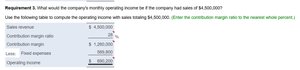
Key formula:
Sales Revenue: The total dollar amount of sales.
Contribution Margin Ratio: Calculated in Q2.
Total Fixed Expenses: Sum of all fixed costs.
Step-by-Step Guidance
Multiply the sales revenue by the contribution margin ratio to find total contribution margin.
Sum the fixed manufacturing overhead and fixed selling & administrative expenses to get total fixed expenses.
Subtract total fixed expenses from total contribution margin to find operating income.
Try solving on your own before revealing the answer!
Final Answer: $690,200
This is the profit earned after covering all fixed expenses for the month at $4,500,000 in sales revenue.
