 Back
BackFinal Exam Review: Calculus and Financial-Accounting Applications
Study Guide - Smart Notes
 Tailored notes based on your materials, expanded with key definitions, examples, and context.
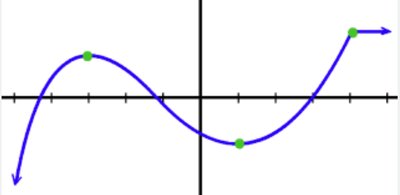
Q1. Find the equation of the secant line from the graph to the right.
Background
Topic: Secant Lines and Average Rate of Change
This question tests your understanding of how to find the equation of a secant line, which connects two points on a function's graph. The secant line represents the average rate of change between those points.
Key Terms and Formulas:
Secant Line: A line passing through two points on a curve.
Average Rate of Change: $m = \frac{f(x_2) - f(x_1)}{x_2 - x_1}$
Point-Slope Form: $y - y_1 = m(x - x_1)$
Step-by-Step Guidance
Identify the two points on the graph where the secant line will be drawn. Let's call them $(x_1, f(x_1))$ and $(x_2, f(x_2))$.
Calculate the slope $m$ of the secant line using $m = \frac{f(x_2) - f(x_1)}{x_2 - x_1}$.
Write the equation of the secant line using the point-slope form: $y - f(x_1) = m(x - x_1)$.
Try solving on your own before revealing the answer!
Final Answer:
The equation of the secant line is $y = m(x - x_1) + f(x_1)$, where $m$ is the slope calculated from the two points.
By plugging in the values from the graph, you can find the specific equation for the secant line.
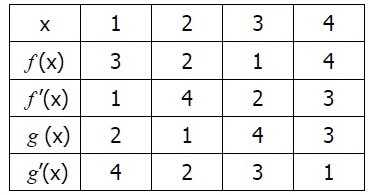
Q2. Given the table below, calculate the following derivatives:
Background
Topic: Product and Quotient Rule for Derivatives
This question tests your ability to use the product and quotient rules to find derivatives using values from a table.
Key Terms and Formulas:
Product Rule: $[f(x)g(x)]' = f'(x)g(x) + f(x)g'(x)$
Quotient Rule: $\left[\frac{f(x)}{g(x)}\right]' = \frac{f'(x)g(x) - f(x)g'(x)}{[g(x)]^2}$
Step-by-Step Guidance
For $p(x) = f(x)g(x)$, use the product rule: $p'(x) = f'(x)g(x) + f(x)g'(x)$.
For $q(x) = \frac{f(x)}{g(x)}$, use the quotient rule: $q'(x) = \frac{f'(x)g(x) - f(x)g'(x)}{[g(x)]^2}$.
Plug in the values from the table for $x = 2$ (for $p'(2)$) and $x = 1$ (for $q'(1)$) as needed.
Try solving on your own before revealing the answer!
Final Answer:
For $p'(2)$, substitute the values from the table into the product rule formula.
For $q'(1)$, substitute the values from the table into the quotient rule formula.
These calculations will give you the derivative values at the specified points.
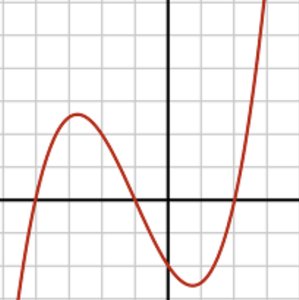
Q3. Find the global and local extrema for $f(x) = 2x^3 - 3x^2 - 36x$ on the interval $[-3, 4]$.
Background
Topic: Extrema and Critical Points
This question tests your ability to find global and local maximum and minimum values of a function on a closed interval using calculus techniques.
Key Terms and Formulas:
Critical Points: Points where $f'(x) = 0$ or $f'(x)$ is undefined.
Global Extrema: The highest and lowest values of $f(x)$ on the interval.
Local Extrema: Maximum or minimum values in a neighborhood.
Step-by-Step Guidance
Find the derivative $f'(x)$ and set it equal to zero to find critical points.
Evaluate $f(x)$ at the critical points and at the endpoints $x = -3$ and $x = 4$.
Compare these values to determine which are global and which are local extrema.
Try solving on your own before revealing the answer!
Final Answer:
The global and local extrema are found by evaluating $f(x)$ at the critical points and endpoints. The largest value is the global maximum, and the smallest is the global minimum.
Check the values at each point to classify them correctly.
