 Back
Merchandise Inventory: Principles, Methods, and Financial Impacts
Study Guide - Smart Notes
 Tailored notes based on your materials, expanded with key definitions, examples, and context.
Merchandise Inventory
Accounting Principles and Controls Related to Merchandise Inventory
Merchandise inventory is a critical asset for merchandising and manufacturing companies. Proper accounting principles and internal controls ensure accurate reporting and safeguard assets.
Consistency Principle: Requires businesses to use the same accounting methods and procedures from period to period, enabling comparability of financial statements. Changes must be disclosed in the notes.
Disclosure Principle: Financial statements must provide sufficient information for external users to make informed decisions. Information should be relevant and faithfully represented.
Materiality Concept: Only significant items that could influence decisions require strict accounting. Materiality depends on the size and nature of the item relative to the business.
Conservatism: When faced with alternatives, accountants should choose the option that least overstates assets and income. Anticipate no gains, but provide for all probable losses.
Inventory Controls: Include proper authorization of purchases, documentation of receipts, recording damaged inventory, annual physical counts, and accurate removal of sold inventory.
Data Analytics in Inventory Management
Modern businesses use data analytics to optimize inventory management. Real-time tracking and analysis help reduce waste and improve profitability.
Example: A restaurant chain monitors inventory every 20 minutes to minimize spoilage and maximize sales.
Inventory Costing Methods Under Perpetual Inventory System
Specific Identification Method
This method assigns the actual cost to each specific unit of inventory. It is used for high-value, easily identifiable items such as automobiles, jewelry, and real estate.
Application: Each item sold or remaining in inventory is tracked individually.
Example: Selling a specific car from inventory at its purchase price.
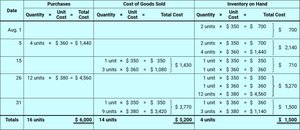
First-In, First-Out (FIFO) Method
FIFO assumes the first units purchased are the first to be sold. Cost of Goods Sold (COGS) is based on the oldest purchases, while ending inventory reflects the most recent costs.
Formula: COGS = Cost of oldest inventory items
Example: If inventory costs are rising, FIFO results in lower COGS and higher net income.
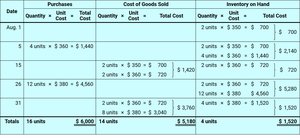
Last-In, First-Out (LIFO) Method
LIFO assumes the last units purchased are the first to be sold. COGS is based on the newest purchases, while ending inventory contains the oldest costs.
Formula: COGS = Cost of newest inventory items
Example: In periods of rising costs, LIFO results in higher COGS and lower net income.
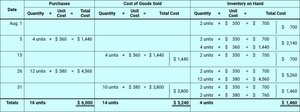
Weighted-Average Method
This method calculates a new weighted-average cost per unit after each purchase. Both COGS and ending inventory are valued at the weighted-average cost.
Formula:
Application: Used for homogeneous inventory items.

Effects of Inventory Costing Methods on Financial Statements
Income Statement Effects
Inventory costing methods affect COGS, gross profit, and net income, especially when costs are rising or falling.
FIFO: Lower COGS, higher net income in rising cost periods.
LIFO: Higher COGS, lower net income in rising cost periods.
Weighted-Average: Results fall between FIFO and LIFO.
Balance Sheet Effects
Inventory valuation impacts asset values and equity.
FIFO: Highest inventory value when costs are rising.
LIFO: Lowest inventory value when costs are rising.
Lower-of-Cost-or-Market Rule
Inventory Valuation
Inventory must be reported at the lower of its historical cost or market value (current replacement cost). This rule ensures assets are not overstated.
Application: If market value drops below cost, inventory is written down.
Example: Inventory purchased for $3,000, replacement cost is $2,200; inventory is reported at $2,200.
Inventory Errors and Their Effects
Impact on Financial Statements
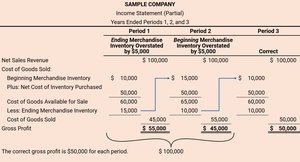
Errors in inventory affect COGS, gross profit, and net income. The effects reverse in the following period.
Overstatement of Ending Inventory: Understates COGS, overstates net income.
Understatement of Ending Inventory: Overstates COGS, understates net income.
Correction: The error cancels out after two periods.
Inventory Turnover and Days’ Sales in Inventory
Inventory Turnover Ratio
This ratio measures how quickly inventory is sold. It is calculated as:
Formula:
Interpretation: High turnover indicates efficient sales; low turnover suggests slow-moving inventory.
Days’ Sales in Inventory
This ratio measures the average number of days inventory is held before being sold.
Formula:
Application: Important for inventory with expiration dates.
Example: If inventory turnover is 7.85, days’ sales in inventory is days.
Inventory Costing Methods Under Periodic Inventory System
Periodic Inventory System Overview
Inventory is not tracked continuously. Purchases are accumulated, and ending inventory is determined at period end.
Formula:
FIFO Method (Periodic)
Ending inventory is valued using the newest costs; COGS uses the oldest costs. Results are the same as FIFO perpetual.
LIFO Method (Periodic)
Ending inventory is valued using the oldest costs; COGS uses the newest costs. Results differ from LIFO perpetual.
Weighted-Average Method (Periodic)
A single weighted-average cost per unit is calculated and applied to both ending inventory and COGS.
Formula:
Additional info: These notes cover all major learning objectives for Chapter 6: Merchandise Inventory, including principles, costing methods, financial statement impacts, error analysis, and performance evaluation ratios.
