 Back
Plant Assets, Natural Resources, and Intangibles: Financial Accounting Study Notes
Study Guide - Smart Notes
 Tailored notes based on your materials, expanded with key definitions, examples, and context.
Plant Assets, Natural Resources, and Intangibles
Overview
This chapter covers the accounting treatment for plant assets, natural resources, and intangible assets. It explains how to measure asset costs, distinguish capital expenditures from immediate expenses, account for depreciation, analyze asset disposals, apply GAAP for natural resources and intangibles, and evaluate the rate of return on assets.
Accounting for the Cost of Plant Assets
Measuring Asset Cost
The cost of a plant asset is the sum of all expenditures necessary to bring the asset to its intended use. These costs include:
Purchase price
Taxes
Commissions
Other costs (e.g., installation, transportation, testing)
Land
Costs include purchase price, brokerage commission, survey fees, legal fees, back property taxes, grading, clearing, and removal of unwanted buildings.
Costs do not include fencing, paving, security systems, or lighting; these are classified as land improvements and are depreciated.
Buildings, Machinery, and Equipment
Construction costs: architectural fees, permits, contractor charges, materials, labor, overhead, and interest on borrowed funds.
Purchase costs: purchase price, commissions, taxes, repairs, and renovations.
Equipment costs: purchase price (net of discounts), transportation, insurance, taxes, commissions, installation, testing, and special platforms.
Land Improvements and Leasehold Improvements
Land improvements: driveways, signs, fences, sprinkler systems, etc.
Leasehold improvements: improvements to leased property, depreciated or amortized over the lease term.
Lump-Sum (Basket) Purchases
When multiple assets are purchased together, the total cost is allocated based on their relative market values using the relative-sales-value method.
Capital Expenditures vs. Immediate Expenses
Definitions
Capital expenditures: Increase asset capacity or extend useful life; costs are capitalized (added to asset account).
Immediate expenses: Costs expensed immediately, typically for small or immaterial amounts.
Accounting Errors
Errors may occur if costs are incorrectly capitalized or expensed.
Leased assets: Both asset and liability appear on the balance sheet.
Depreciation of Plant Assets
Depreciation Concepts
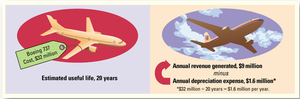
Depreciation allocates the cost of a plant asset to expense over its useful life. It reflects asset wear, obsolescence, and value loss. Depreciation expense is reported on the income statement. Land is not depreciated.
Depreciation Measurement
Cost: Purchase price plus all costs to ready the asset.
Estimated Useful Life: Expected period of asset use.
Estimated Residual Value: Expected value at end of useful life.
Depreciation Methods
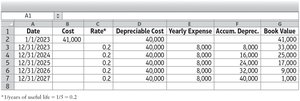
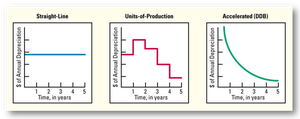
Straight-line method: Equal depreciation each period.
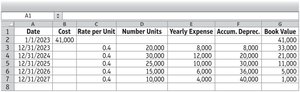
Units-of-production method: Depreciation based on asset usage.
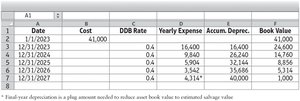
Double-declining-balance method: Accelerated depreciation, higher expense early in asset life.
Straight-Line Method
Annual depreciation expense is calculated as:
Formula:
Units-of-Production Method
Depreciation is based on asset output:
Formula:
Annual expense: Depreciation per unit × units produced in period
Double-Declining-Balance Method
Accelerated depreciation method:
Formula:
Residual value is ignored initially; final year depreciation is a "plug" to reach residual value.
Comparing Depreciation Methods
Straight-line: Best for assets generating revenue evenly.
Units-of-production: Best for assets worn out by use.
Double-declining-balance: Best for assets generating more revenue early.
Depreciation Methods in Practice
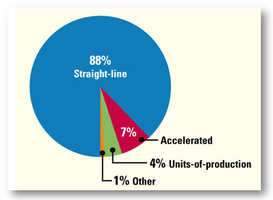
Most companies use straight-line for financial reporting.
Accelerated methods (e.g., DDB) are used for tax purposes to maximize deductions.
Other Issues in Accounting for Plant Assets
Tax Implications
Accelerated depreciation reduces taxable income and conserves cash.
Fully Depreciated Assets
Assets at end of useful life may still be used, but no further depreciation is recorded.
Upon disposal, remove asset cost and accumulated depreciation from records.
Plant Asset Disposal
Disposal Process
Update depreciation to date of disposal.
Measure final book value and record expense.
Record sale or removal of asset, including any gain or loss.
Accounting for Natural Resources and Intangible Assets
Intangible Assets
Long-term assets with no physical form, but carry special rights.
Examples: patents, copyrights, trademarks, franchises, goodwill.
Finite lives: amortization recorded.
Indefinite lives: checked annually for impairment.
Patents
Granted by government, exclusive rights for 20 years.
Copyrights
Exclusive rights to reproduce and sell works; extend 70 years beyond author’s life.
Trademarks and Trade Names
Distinctive product/service identifications; amortized if finite life, otherwise not.
Franchises and Licenses
Right to sell products/services under specified conditions; often indefinite lives.
Goodwill
Excess purchase cost over net asset value; only recorded when purchased.
Subject to impairment testing, not amortization.
Rate of Return on Assets
Return on Assets (ROA)
ROA measures how efficiently assets generate net income:
Formula:
Higher ROA indicates more effective asset utilization.
Additional info: Academic context and formulas have been expanded for clarity and completeness. Tables and images included are directly relevant to the explanation of depreciation methods and their application.
