 Back
BackPlant Assets, Natural Resources, and Intangibles: Comprehensive Study Notes
Study Guide - Smart Notes
 Tailored notes based on your materials, expanded with key definitions, examples, and context.
Plant Assets, Natural Resources, and Intangibles
Introduction
This chapter covers the accounting for plant assets, natural resources, and intangible assets. It explains how to measure, depreciate, and report these long-lived assets, as well as how to handle their disposal, impairment, and the impact on financial statements and cash flows. The chapter also discusses differences between U.S. GAAP and IFRS, and the influence of ESG factors.
Accounting for the Cost of Plant Assets
Definition and Measurement
Plant assets are tangible long-lived assets used in operations, such as land, buildings, and equipment.
The cost of a plant asset is the sum of all expenditures necessary to acquire the asset and prepare it for its intended use.
Costs include purchase price, taxes, commissions, and costs to make the asset ready for use.
Land
Costs included: purchase price, brokerage commission, survey fees, legal fees, back property taxes, grading, clearing, and removal of unwanted buildings.
Costs not included: fencing, paving, security systems, lighting (these are land improvements and are depreciated separately).
Buildings, Machinery, and Equipment
Building construction costs: architectural fees, permits, contractor charges, materials, labor, overhead, and interest during construction.
Building purchase costs: purchase price, commissions, taxes, repairs, and renovations.
Equipment costs: purchase price (less discounts), transportation, insurance in transit, taxes, commissions, installation, testing, and special platforms.
Land Improvements and Leasehold Improvements
Land improvements: driveways, signs, fences, sprinkler systems, etc. (depreciated over useful life).
Leasehold improvements: improvements to leased property, amortized over the lease term.
Lump-Sum (Basket) Purchases
When multiple assets are purchased together, the total cost is allocated based on relative market values (relative-sales-value method).
Capital Expenditures vs. Immediate Expenses
Definitions
Capital expenditures: Costs that increase an asset’s capacity or extend its useful life; added to the asset account.
Immediate expenses: Costs that are expensed as incurred, typically for routine maintenance or immaterial amounts.
Leased Assets
Leasing allows use of assets without large upfront payments.
Most leases result in both a right-of-use asset and a lease liability on the balance sheet.
Depreciation of Plant Assets
Concept and Purpose
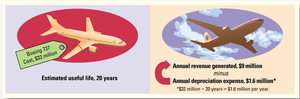
Depreciation allocates the cost of a plant asset over its useful life.
Reported as depreciation expense on the income statement; land is not depreciated.
Key Terms in Depreciation
Cost: All expenditures to acquire and prepare the asset.
Estimated useful life: Expected period of use.
Estimated residual value: Expected value at end of useful life.
Depreciation Methods
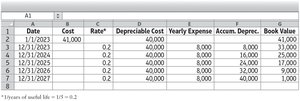
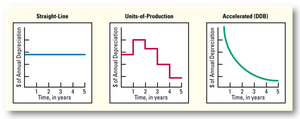
Straight-line method: Allocates equal depreciation each period.
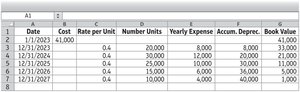
Units-of-production method: Depreciation based on usage or output.
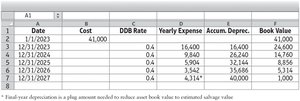
Double-declining-balance (DDB) method: Accelerated method, higher depreciation in early years.
Straight-Line Method Example
Annual Depreciation Expense = (Cost - Residual Value) / Useful Life
Units-of-Production Method Example
Depreciation per Unit = (Cost - Residual Value) / Total Estimated Units
Double-Declining-Balance Method Example
Annual Depreciation Expense = Book Value at Beginning of Year × (2 / Useful Life)
Comparing Depreciation Methods
Straight-line: Even expense, best for assets generating revenue evenly.
Units-of-production: Best for assets that wear out with use.
DDB: Best for assets generating more revenue early in life.
Depreciation Methods in Practice
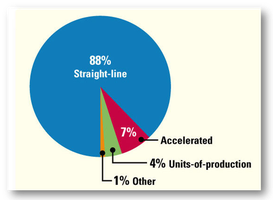
Most companies use straight-line depreciation for financial reporting.
Other Issues in Accounting for Plant Assets
Tax Depreciation
Accelerated methods (e.g., DDB, MACRS) are often used for tax purposes to maximize deductions and conserve cash.
Partial-Year Depreciation
Depreciation is prorated for assets acquired or disposed of during the year.
Changes in Useful Life
Changes are treated as changes in accounting estimates and applied prospectively.
Fully Depreciated Assets
Assets can continue to be used, but no further depreciation is recorded.
Remove asset and accumulated depreciation from the books upon disposal.
Disposal of Plant Assets
Accounting for Disposal
Update depreciation to date of disposal.
Remove asset and accumulated depreciation from the books.
Record any gain or loss on disposal.
GAAP vs. IFRS: Depreciation and Asset Reporting
GAAP: Uses historical cost and depreciates composite assets.
IFRS: Uses component approach, depreciating each significant part separately; allows reversal of impairment losses in some cases.
Natural Resources and Intangible Assets
Natural Resources
Examples: oil, minerals, timber.
Depletion allocates cost as resources are extracted and sold.
Intangible Assets
No physical substance; carry special rights (e.g., patents, copyrights, trademarks, franchises, goodwill).
Finite life intangibles are amortized; indefinite life intangibles are tested for impairment.
Goodwill
Excess of purchase price over fair value of net assets acquired; only recorded when purchased.
Tested for impairment, not amortized.
Research and Development (R&D) Costs
Expensed as incurred under U.S. GAAP; some development costs may be capitalized under IFRS if criteria are met.
Asset Impairment
Definition and Process
Occurs when expected future cash flows are less than the asset’s book value.
Impairment loss is recognized to reduce carrying value to fair value.
Rate of Return on Assets (ROA)
Definition and Calculation
Measures how efficiently assets generate net income.
Formula:
DuPont Analysis:
ESG Factors and Long-Lived Assets
Environmental, Social, and Governance (ESG) factors can affect asset values, useful lives, and impairment assessments.
Examples: regulatory changes, reputational risks, and shifts in societal values.
Cash Flow Impact of Long-Lived Asset Transactions
Statement of Cash Flows
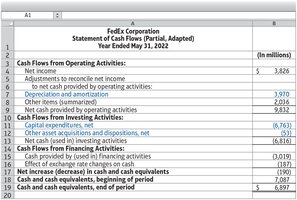
Acquisitions: Investing outflows.
Sales: Investing inflows.
Depreciation/amortization: Added back to net income in operating activities (non-cash expense).
Calculating Depreciation Using Excel Functions
SLN function: Calculates straight-line depreciation.
DDB function: Calculates double-declining-balance depreciation.
Summary Table: Depreciation Methods Comparison
Method | Best For | Expense Pattern |
|---|---|---|
Straight-Line | Assets generating revenue evenly | Equal each year |
Units-of-Production | Assets that wear out with use | Varies with usage |
Double-Declining-Balance | Assets generating more revenue early | Higher in early years |
Additional info: These notes expand on the provided slides and images with academic context, definitions, and formulas to ensure a comprehensive, self-contained study guide for financial accounting students.
