 Back
Plant Assets, Natural Resources, and Intangibles: Financial Accounting Study Notes
Study Guide - Smart Notes
 Tailored notes based on your materials, expanded with key definitions, examples, and context.
Plant Assets, Natural Resources, and Intangibles
Overview
This chapter covers the accounting treatment for plant assets, natural resources, and intangible assets. It explains how to measure asset costs, distinguish capital expenditures from immediate expenses, account for depreciation, analyze asset disposals, apply GAAP for natural resources and intangibles, and evaluate the rate of return on assets.
Accounting for the Cost of Plant Assets
Measuring Asset Cost
The cost of a plant asset is the sum of all expenditures necessary to bring the asset to its intended use. This includes:
Purchase price
Taxes
Commissions
Other costs (e.g., installation, transportation, testing)
Land
Costs include: purchase price, brokerage commission, survey fees, legal fees, back property taxes, grading and clearing, removal of unwanted buildings.
Costs do not include: fencing, paving, security systems, lighting (these are land improvements and depreciated separately).
Buildings, Machinery, and Equipment
Construction costs: architectural fees, permits, contractor charges, materials, labor, overhead, interest on borrowed funds.
Purchase costs: purchase price, commissions, taxes, repairs, renovations.
Equipment costs: purchase price (net of discounts), transportation, insurance, taxes, installation, testing, special platforms.
Land Improvements and Leasehold Improvements
Land improvements: driveways, signs, fences, sprinkler systems, etc. (depreciated over useful life).
Leasehold improvements: improvements to leased property, depreciated or amortized over lease term.
Lump-Sum (Basket) Purchases
When multiple assets are purchased together, the total cost is allocated based on relative market values using the relative-sales-value method.
Capital Expenditures vs. Immediate Expenses
Definitions and Distinctions
Capital expenditures: Increase asset capacity or extend useful life; costs are capitalized (added to asset account).
Immediate expenses: Costs expensed in the period incurred; typically small or immaterial costs.
Errors may occur if costs are incorrectly capitalized or expensed.
Leased assets: Both asset and liability appear on the balance sheet.
Depreciation of Plant Assets
Depreciation Concepts
Depreciation allocates the cost of a plant asset to expense over its useful life, reflecting wear, obsolescence, and value loss. Depreciation expense is reported on the income statement. Land is not depreciated.
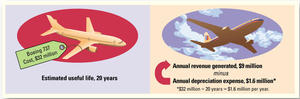
Key Depreciation Terms
Cost: Purchase price plus all costs to ready asset for use.
Estimated Useful Life: Expected period of asset use.
Estimated Residual Value: Expected value at end of useful life.
Depreciation Methods
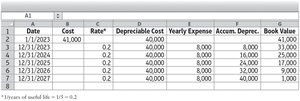
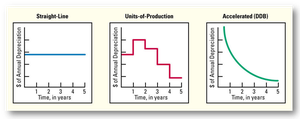
Straight-line method: Equal depreciation each period.
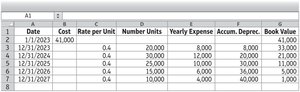
Units-of-production method: Depreciation based on asset usage.
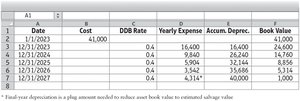
Double-declining-balance method: Accelerated depreciation, higher expense early in asset life.
Straight-Line Method
Annual depreciation expense is calculated as:
Depreciation recorded via Accumulated Depreciation account.
Depreciation Expense reduces equity.
Units-of-Production Method
Depreciation per unit is:
Multiply per-unit amount by units produced each period.
Double-Declining-Balance Method
Depreciation expense is calculated as:
Residual value is ignored initially; final year depreciation is a "plug" to reach residual value.
Comparing Depreciation Methods
Straight-line: Best for assets generating revenue evenly.
Units-of-production: Best for assets that wear out due to use.
Double-declining-balance: Best for assets generating more revenue early in life.
Depreciation Methods in Practice
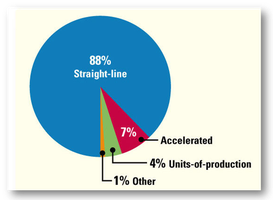
Most companies use straight-line for financial reporting.
Accelerated methods (e.g., DDB) are often used for tax purposes to maximize deductions.
Other Issues in Accounting for Plant Assets
Tax Implications
Accelerated depreciation reduces taxable income and conserves cash.
Fully Depreciated Assets
Assets at end of useful life may still be used, but no further depreciation is recorded.
Remove asset cost and accumulated depreciation upon disposal.
Plant Asset Disposal
Disposal Process
Update depreciation to date of disposal.
Measure final book value.
Record gain or loss on sale.
Natural Resources and Intangible Assets
Intangible Assets
Long-term assets with no physical form, but carry special rights.
Examples: patents, copyrights, trademarks, franchises, goodwill.
Finite lives: Amortization recorded.
Indefinite lives: Checked annually for impairment.
Patents
Exclusive right to produce/sell invention for 20 years.
Copyrights
Exclusive right to reproduce/sell artistic work; lasts 70 years beyond author’s life.
Trademarks and Trade Names
Distinctive product/service identification; amortized if finite, not if indefinite.
Franchises and Licenses
Right to sell product/service under specified conditions; often indefinite lives.
Goodwill
Excess purchase cost over net asset value of acquired company.
Only recorded when purchased; subject to impairment testing.
Rate of Return on Assets
Return on Assets (ROA)
ROA measures how efficiently assets generate net income:
Higher ROA indicates more effective asset utilization.
Additional info: Academic context and formulas have been added to clarify depreciation methods, asset allocation, and intangible asset treatment.
